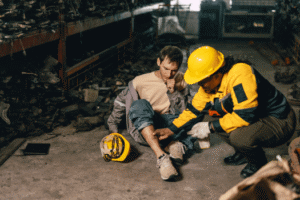


Workers’ comp covers your medical bills and part of your paycheck. It also takes away your right to sue some people. The question that decides whether you have a second case is simple to ask and hard to answer: who can I sue for a work injury, and who is off-limits?
Most injured workers in Las Vegas get the answer wrong in one of two ways. Some assume comp means they can’t sue anyone. Others assume any company on the job site is fair game. Nevada law draws the line somewhere in between, and contracts, licenses and job arrangements decide where it falls. This guide walks through that line so you know what to ask before a deadline passes.

Who Can I Sue for a Work Injury?
Think of workers’ comp as a circle. Inside the circle are your employer, your coworkers and certain companies Nevada treats as if they were your employer. In most cases, comp is your only remedy against anyone inside it.
Everyone outside the circle is a potential “third party.” If a third party’s carelessness caused your injury, you can usually keep collecting comp and also bring a personal injury claim against them. That second claim can pay for losses comp never covers, like pain and suffering and the full value of your lost wages.
First, your injury has to count as a work injury. If you’re unsure, start with what Nevada treats as a work injury. Then the real question becomes which side of the circle the person who hurt you stands on.
Who You Usually Can’t Sue
Your Employer
Nevada’s workers’ compensation law makes comp the exclusive remedy against an employer that carries the required coverage. In plain terms, you generally can’t sue the company that employs you for a workplace injury, even if its carelessness caused it. In exchange, you get benefits without having to prove anyone was at fault. If you need a refresher on how those benefits work, see our guide to understanding workers’ compensation in Nevada.
Coworkers Doing Their Jobs
The same protection generally extends to people “in the same employ.” If a coworker drops a load on you or backs a company forklift into you while doing their job, the claim usually runs through comp, not a lawsuit against that coworker.
Companies Nevada Treats Like Your Employer
This is the group that surprises people. Nevada law can treat some companies that never signed your paycheck as your employer for comp purposes. That makes them immune too.
- On construction projects, a licensed contractor doing the work it’s licensed for, under a contract tied to a licensed principal contractor, is often treated as a co-employee. That can include other subcontractors on the same project.
- Property owners who hire a licensed general contractor for a construction project are often immune for injuries that happen during that project.
- Outside construction, courts ask whether the work you were doing is the kind of work the company normally handles through its own employees. If it is, that company may be inside the circle.
None of this is automatic. Whether a company is protected depends on its license, the contracts in the chain and the work being done when you were hurt. That’s exactly why a third-party workplace injury lawyer in Las Vegas pulls those documents before telling you whether you have a case.
Who Usually Counts as a Third Party
Drivers From Outside Your Company
If you were injured while driving for work, the other driver is usually a third party. That holds whether you were making deliveries, driving between job sites on I-15 or US-95, or parked on a service call in Spring Valley. Comp covers part of your losses, and the at-fault driver’s insurance can be responsible for the rest. Our Las Vegas motor vehicle accident team handles the crash side of these claims.
Equipment Makers and Sellers
A ladder that collapses, a saw with a missing guard or a lift with a faulty control can point to the company that designed, built or sold it. Nevada law can hold a maker responsible for a defective product without proving it was careless. You still have to show the defect and that it caused your injury. That’s why the equipment itself is often the most important evidence in the case.
Businesses You Visit for Work
Delivery drivers, repair techs, installers and sales reps spend their days on other people’s property. If you slip on a customer’s broken stairs or get hurt by a hazard at a business you were sent to, that property owner is often a third party. These claims follow premises liability rules, including what the owner knew about the hazard.
Animal Owners
Mail carriers, meter readers and home-service workers get bitten on the job more often than most people realize. The dog’s owner is usually outside the comp circle. We cover that situation in detail in dog bites at work in Las Vegas.
Gray Areas Where Workers Give Up Too Early
Temp and Staffing Workers
If a staffing agency placed you at another company, two businesses may claim the protection of the comp circle. Whether the company where you were working can be sued depends on the arrangement between it and the agency and on who controlled your work. The answer is fact-specific, so don’t assume either way.
Gig and 1099 Drivers
Many app-based delivery and rideshare drivers are classified as independent contractors. That can mean there’s no workers’ comp at all. If you were hit while delivering, the crash claim may be your main claim rather than a second one. How you’re classified can also be challenged, and that changes the picture.
When Your Employer Had No Comp Coverage
Nevada requires most employers to carry workers’ comp. When an employer skips it, the protection that normally shields it may not apply. Injured workers in that position may be able to pursue the employer directly or seek benefits through the state’s program for uninsured employers.
When an Employer Meant to Hurt You
There’s a narrow exception for intentional harm. The bar is high: Nevada requires showing the employer deliberately and specifically intended to injure you. An employer that knew about a dangerous condition and ignored it usually doesn’t meet that standard. Those cases go back to comp and any available third party.
Why the Other Side Fights This Question First
Glen Howard spent years as an insurance defense attorney before he started representing injured people. He knows the first move a defense lawyer makes when a worker sues a contractor on a job site. They argue the company is inside the comp circle and ask the court to throw the case out.
That defense rests on paperwork: contractor licenses, subcontracts, and who hired whom. If your lawyer doesn’t have those documents early, the insurer frames the story first. It also means a claim that looks dead at first glance can turn out to be strong once someone checks whether the company was properly licensed or actually part of the contract chain.
What to Gather So a Lawyer Can Answer It
You don’t have to sort out immunity yourself. You just need to save the facts that let someone else sort it out:
- The name of every company involved. Look at trucks, uniforms, safety vests, equipment tags and the job-site permit board.
- Who supervised the work that hurt you, and whose crew they belonged to.
- The crash report if a vehicle was involved, plus the other driver’s insurance information.
- The make, model and condition of any equipment involved. Ask that it not be repaired or thrown away.
- Names of witnesses, especially workers from other companies.
- Nothing signed and no recorded statement given to another company’s insurer before you talk to a lawyer.
If you’re still in the first days after an injury, our guide for when you’ve been hurt on the job covers reporting, medical care and the first steps that protect both claims.
Your Deadlines Run on Separate Clocks
Your workers’ comp claim and your third-party claim run on different timelines. Comp has its own short reporting and filing deadlines. A personal injury claim against a third party in Nevada generally must be filed within two years of the injury. Claims against a government agency follow their own rules and come with a cap on damages.
Comp also generally gets paid back from a third-party recovery. Nevada changed how much the comp insurer can take back in 2025, and how a settlement is structured affects what you keep. Because every case is different, talk to an attorney before you agree to any third-party settlement.

Frequently Asked Questions
Can I sue my coworker for a work injury in Nevada?
Usually not. Nevada’s comp system generally protects people “in the same employ,” so a coworker who injures you while doing their job is typically inside the comp circle. Your remedy runs through workers’ comp. The picture can change when the person who hurt you only looks like a coworker but works for a different company on the same site, or when an outside party shares the blame. In those cases, it matters whether that company is treated as a co-employee under Nevada law. That turns on licenses, contracts and the type of work being done. A Las Vegas attorney can review who employed the other worker before you rule out a claim.
Can a temp worker sue the company they were placed with?
Sometimes, but it depends on the arrangement. When a staffing agency places you at another business, both companies may argue they’re protected by workers’ comp. Whether the company you were placed with can be sued depends on the agreement between it and the agency, who controlled your daily work and how comp coverage was handled. Some temp workers have no claim against the placement company. Others do, especially when a third company, a defective piece of equipment or an outside driver caused the injury. Keep your agency paperwork and pay stubs, and have a lawyer review the setup.
Can I sue the property owner if I was hurt on a construction site?
Often not, if the owner hired a licensed general contractor for the project. Nevada courts have held that an owner who contracts with a licensed principal contractor can be protected from suits over injuries during that construction work, the same way the contractor is. That protection has limits. It depends on the contractor’s license and the contracts in place, and it applies to the construction project itself. An owner whose separate hazard hurt you outside the project’s scope, or a manufacturer of faulty equipment on site, may still be responsible. A construction site accident lawyer in Las Vegas will check the licensing and contract chain first.
Can I sue my employer if they didn’t have workers’ comp?
You may be able to. Nevada requires most employers to carry workers’ compensation insurance. The rule that stops you from suing your employer generally assumes the employer had that coverage. When an employer is uninsured, injured workers may have options that aren’t normally available. That can include pursuing the employer directly or seeking benefits through Nevada’s program for workers of uninsured employers. Which path makes sense depends on the employer’s assets, your injuries and whether a third party is also involved. Talk to an attorney before choosing, because the choice can affect what you recover.

Not Sure Which Side of the Line They’re On?
You shouldn’t have to read contractor licenses and subcontracts to find out whether you have a second case. That’s our job. Howard Injury Law focuses on claims beyond workers’ comp: the driver, manufacturer, property owner or outside company that caused your injury.
Glen Howard knows how insurers build the “they’re immune” defense because he used to build it for them. Tell us what happened and who was involved, and we’ll tell you whether someone outside the comp circle owes you. There’s no fee unless we win.
Get your free case review and find out if a third party is responsible for your work injury.