


Your X-ray came back clean, and now the insurance adjuster is acting like your pain isn’t real. That’s the trap with soft tissue injuries: the damage is genuine, but it doesn’t show up on a scan — which hands the insurance company an excuse to call you an exaggerator and offer a fraction of what your claim is worth. A soft tissue injury car accident lawyer in Las Vegas is built for exactly this fight: proving an injury the insurer swears isn’t there and making them pay for it.
Whether you were rear-ended on I-15, T-boned at an intersection like Sahara and Decatur, or hit anywhere across the valley, this guide covers what soft tissue injuries are, why insurers underpay them, how you actually prove one under Nevada law, and what a lawyer does to protect the value of your claim.

What Are Soft Tissue Injuries?
Soft tissue injuries damage the muscles, tendons, ligaments, and connective tissue that hold your body together — everything except bone. In a crash, the force of impact stretches, tears, or bruises that tissue, even at speeds low enough to leave your car barely dented.
Common soft tissue injuries after a Las Vegas crash include:
- Whiplash — the neck strain that happens when your head snaps forward and back, and the most common soft tissue injury in rear-end collisions.
- Sprains — stretched or torn ligaments, often in the neck, back, shoulders, or knees.
- Strains — overstretched or torn muscles and tendons.
- Contusions — deep bruising from contact with a seat belt, airbag, dashboard, or steering wheel.
- Tears — ligament or tendon tears that can require injections or surgery.
These range from a few weeks of stiffness to chronic pain that reshapes how you work and sleep for years.
Why symptoms are often delayed
Adrenaline masks pain. Many people walk away from a crash near the Spring Valley or Summerlin off-ramps feeling shaken but “fine,” then wake up two or three days later barely able to turn their neck. That delay is normal for soft tissue damage — and it’s also why insurers pounce when there’s a gap between the crash and your first doctor’s visit. Knowing which symptoms to watch for after a crash helps you get care before that gap becomes their argument.
Why Insurance Companies Lowball Soft Tissue Injury Claims
Insurers treat soft tissue claims differently than broken bones, and it’s deliberate. A fracture shows up in black and white on an X-ray. A torn ligament or strained muscle usually doesn’t. So the adjuster leans on that gap.
The playbook is predictable:
- “The X-rays were negative, so there’s no real injury.”
- “Your car barely had a scratch, so you couldn’t be badly hurt.”
- “You waited too long to see a doctor.”
- “That’s a pre-existing condition, not our crash.”
Glen Howard spent years on the other side of this — defending insurance companies before he started representing injured people. He knows how adjusters are trained to score soft tissue claims low and close them fast, because he used to see the internal math. That’s the difference between a claim the insurer brushes off and one they have to take seriously. The Las Vegas car accident team at Howard Injury Law builds soft tissue claims specifically to shut down each of those talking points before they’re used.
How to Prove a Soft Tissue Injury After a Car Accident in Nevada
Because these injuries don’t announce themselves on an X-ray, proving one is about building a consistent, documented record that ties the crash to your pain. Under Nevada law, you carry the burden of showing the other driver’s negligence caused your injury — so the evidence has to do the talking.
What actually proves a soft tissue injury:
- Prompt medical care. See a doctor within a day or two, even if it feels minor. The first record anchors everything after it.
- The right imaging. X-rays rule out fractures but miss soft tissue. An MRI can show tears, disc damage, and inflammation an X-ray can’t. If a doctor suspects a tear, imaging matters.
- Consistent treatment records. Every appointment, diagnosis, and note is a data point connecting your symptoms to the collision. Handling your medical bills and records the right way keeps that trail clean.
- No treatment gaps. Skipping weeks of care tells the insurer you got better — or were never hurt.
- Your own record. A short daily note on pain, stiffness, missed work, and what you can no longer do is both admissible and persuasive.
- Physician and expert opinions. A treating doctor — and, when needed, a medical expert — can connect the mechanics of the crash to your specific injury.
For neck and back cases especially, documentation of soft tissue damage to the neck and back is often the deciding factor between a denied claim and a paid one.
Every case is different, and none of this is legal advice for your exact situation — but the pattern holds: the stronger and more consistent your record, the less room the insurer has to argue the injury away.
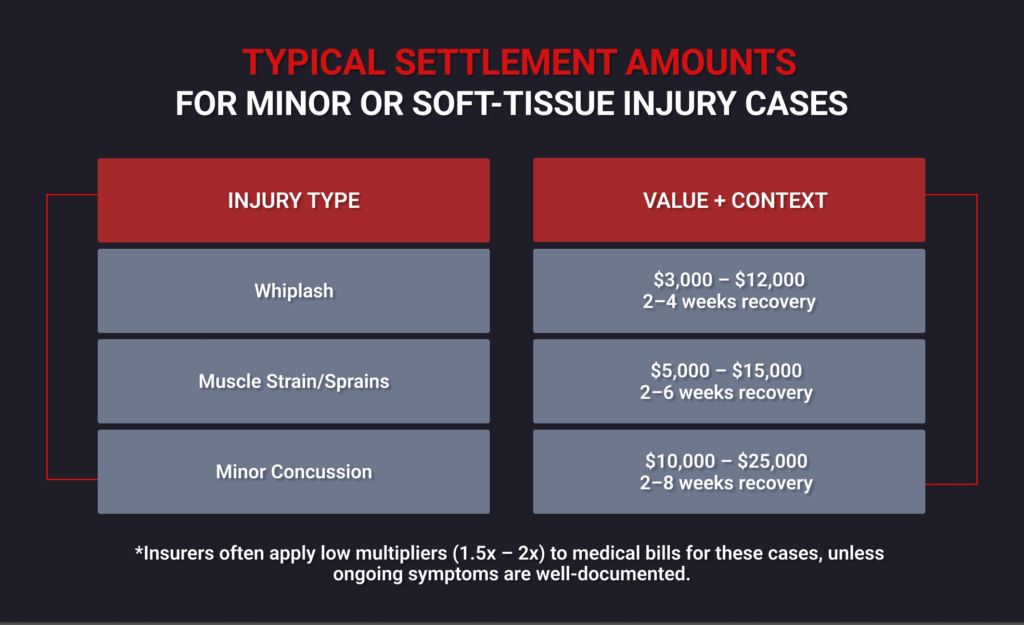
What Affects the Value of a Soft Tissue Injury Claim in Nevada
No two soft tissue claims are worth the same, and any lawyer who quotes a number before reviewing your records is guessing. What genuinely moves the value:
- Severity and diagnosis — a mild strain that clears up in a month is not a torn ligament that needs injections or surgery.
- Length and type of treatment — ongoing care signals a more serious injury.
- Permanence — lasting pain or reduced range of motion raises value.
- Impact on your life — missed work, lost income, and activities you’ve had to give up all count.
- Fault — Nevada uses modified comparative negligence. If you’re partly at fault, your recovery drops by your share; if you’re more than 50% at fault, you generally can’t recover at all. Insurers know this and will try to pin blame on you to shrink the payout.
Your claim also splits into economic damages (medical bills, lost wages) and non-economic damages — the pain and suffering a soft tissue injury causes, which is often the larger and more contested piece. For the full picture of how these factors combine, see how much a car accident case is worth in Las Vegas.
Does Physical Therapy and Medical Treatment Affect Your Claim?
Yes — but not the way some people assume. Physical therapy isn’t about running up a bill. Consistent, doctor-directed treatment does two things at once: it helps you actually recover, and it creates the medical record that proves your injury was real and needed care.
The reverse is where people hurt their own claims. Gaps in treatment, skipped appointments, or quitting therapy early are exactly what an adjuster points to when arguing you weren’t really injured. Follow the plan your doctor sets because it’s what your body needs — the documented recovery is a byproduct, not the goal. If cost is the reason you’re avoiding care, there are ways to get medical treatment covered after a crash that an attorney can walk you through.
How a Las Vegas Soft Tissue Injury Lawyer Strengthens Your Claim
Handle a soft tissue claim alone and you’re negotiating against an adjuster whose job is to pay you as little as possible — and who’s counting on you not knowing what the claim is worth. A lawyer changes that math.
What representation actually does:
- Builds the medical and evidentiary record so the injury can’t be waved off.
- Counters the “minor impact” and “pre-existing condition” arguments before they take hold.
- Values your non-economic damages properly instead of accepting the adjuster’s first number.
- Handles every conversation with the insurer, so nothing you say gets twisted against you.
- Files suit before Nevada’s deadline if the insurer won’t deal fairly.
That last point matters: in Nevada, you generally have two years from the date of the crash to file a lawsuit. Miss it, and even an airtight injury claim can be dismissed.
Howard Injury Law works on contingency — no fee unless we win — so having your soft tissue claim evaluated costs you nothing. Because Glen Howard built his career defending insurers, the firm’s car accident practice knows the exact tactics coming and how to beat them — the same knowledge, now working for you instead of against you. Soft tissue claims are one piece of the broader motor vehicle accident practice serving injured drivers across the Las Vegas valley.
Frequently Asked Questions
How much is a soft tissue injury claim worth in Las Vegas?
There’s no flat answer — value depends on how severe your injury is, how long you treat, whether the damage is permanent, your lost income, and how much fault the insurer tries to assign you. A minor strain and a torn ligament that needs injections sit in very different ranges, so any number quoted before your records are reviewed is a guess. The honest way to get a real figure is a records review with an attorney. For a deeper breakdown of the factors that drive value, see how much a car accident case is worth in Las Vegas.
How do you prove a soft tissue injury if it doesn’t show on an X-ray?
You prove it with everything else. X-rays rule out fractures but don’t capture soft tissue, so the case is built on an MRI when appropriate, consistent medical records, your treating physician’s diagnosis, a treatment history with no unexplained gaps, and your own daily notes on pain and limitations. Photos, the police report, and witness statements tie the crash to the injury. The more consistent the record, the harder it is for an insurer to claim the injury isn’t real — which is exactly why the paperwork matters as much as the pain.
Will physical therapy increase my settlement?
Not on its own, and you shouldn’t do therapy to inflate a claim. What matters is that following your doctor’s treatment plan — physical therapy included — documents that your injury was real and required care, which supports your claim’s value. Skipping or stopping treatment early does the opposite: it hands the insurer a reason to argue you recovered or were never seriously hurt. Do the treatment your doctor prescribes because your recovery depends on it. The stronger medical record is a byproduct of getting better, not the reason to go.
What’s the average car accident settlement in Las Vegas?
Averages are close to meaningless for your specific case, because settlements swing widely based on injury severity, fault, and insurance limits — a soft tissue claim and a claim involving surgery aren’t comparable. If you want the context on typical ranges, see the average car accident settlement in Las Vegas, then get your own claim evaluated for a number that actually applies to you.
Is whiplash a soft tissue injury?
Yes. Whiplash is one of the most common soft tissue injuries in car accidents, caused when the head is thrown forward and back, straining the muscles and ligaments in the neck. It often comes with delayed symptoms and doesn’t show on an X-ray, which is why insurers frequently dispute it. If whiplash is your main injury, the whiplash injury car accident lawyer resource covers that specific claim in more detail.
How long do I have to file a soft tissue injury claim in Nevada?
Generally two years from the date of the crash, under Nevada law (NRS 11.190(4)(e)). That deadline applies to filing a lawsuit — not to settling with an insurer, which is a separate process the clock keeps running through. Narrow exceptions exist, so if you’re near the deadline, talk to an attorney quickly. Waiting also lets evidence fade and treatment gaps grow, both of which weaken the claim.

Don’t Let a Clean X-ray Decide What You’re Owed
You’re not exaggerating, and a clean X-ray doesn’t mean you’re not hurt. If an adjuster is treating your soft tissue injury like it doesn’t count, that’s the signal to get someone in your corner who can prove it does.
Howard Injury Law offers a free consultation to review what happened, look at your records, and tell you honestly whether you have a case — no fee unless we win. Call (702) 331-5722 or reach out through our contact page to find out what your soft tissue injury claim is actually worth.