


If an adjuster has already floated a number after your rear-end crash, take a breath before you say yes. A rear-end accident settlement in Nevada has no fixed price tag — it’s built from your injuries, your treatment, your lost income, and the at-fault driver’s insurance limits, and the first offer is almost never what the claim is actually worth.
You were hit from behind, your neck and back are paying for it, and the bills are stacking up. This guide walks through what drives the value of a rear-end claim in Las Vegas, realistic ranges by injury severity, and why being the rear-ended driver usually puts Nevada law on your side.
What Determines a Rear-End Accident Settlement in Nevada
No blog can tell you what your specific case is worth, and any that promises a number is guessing. Settlement value comes from adding up your economic losses — medical bills, lost wages, future care — then accounting for non-economic harm like pain and the disruption to your daily life. The at-fault driver’s policy limits then cap how much their insurer is required to pay.
Two rear-end crashes at the same intersection can settle for wildly different amounts. A sore neck that resolves in a month is not the same claim as a herniated disc that needs injections. If you’re weighing the broader question of value across any collision type, our overview on how much a car accident case is worth in Las Vegas covers the general framework. Below, we stay specific to rear-end crashes.
Typical Rear-End Settlement Ranges by Injury Severity
The ranges below are general illustrations, not predictions. Every case turns on its own facts, and yours could land above or below these figures depending on documentation, treatment, and the insurance available. Use them to understand the pattern, not to price your claim — that’s a conversation for an attorney who has seen the file.
Minor Soft Tissue and Whiplash Injuries
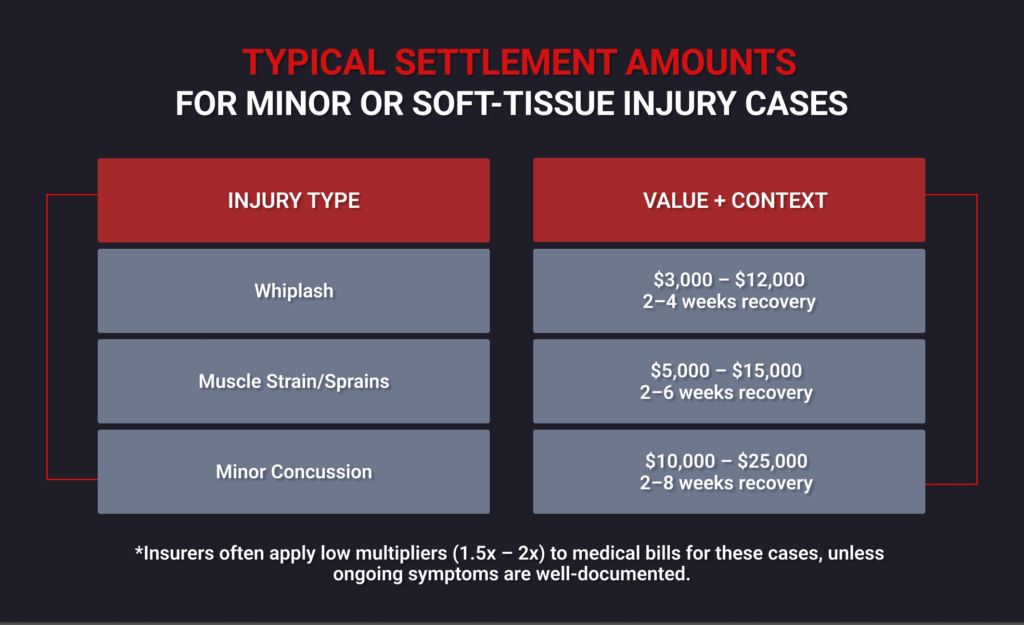
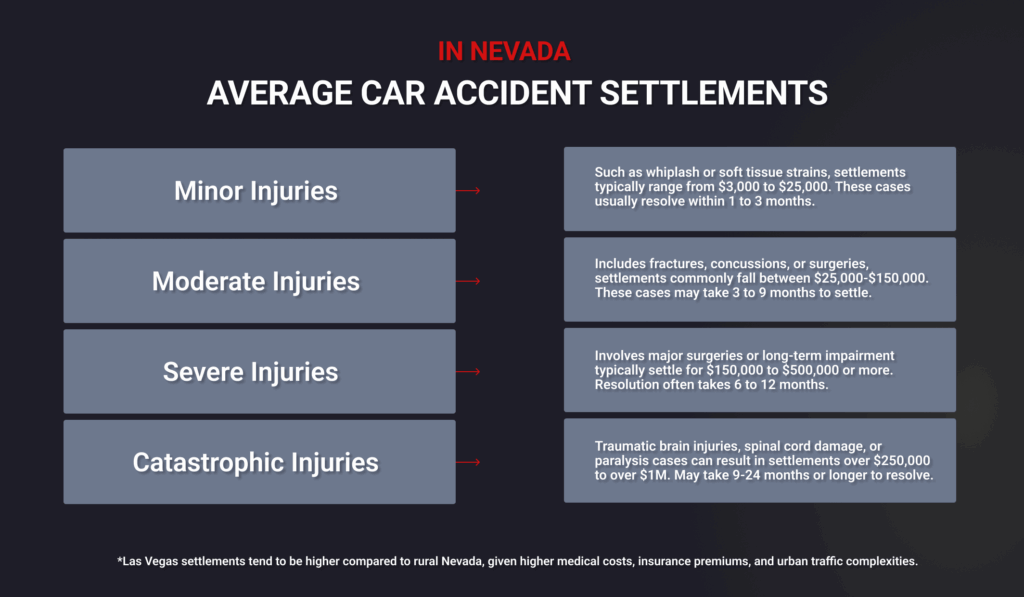
Most rear-end crashes produce soft tissue injuries — whiplash, neck and back strains, sprains that heal with a few weeks of physical therapy. Claims in this tier commonly settle in the $3,000 to $12,000 range when recovery is short and complete.
The catch: insurers treat soft tissue injuries with suspicion because they don’t show up on an X-ray. Consistent medical records and following your treatment plan are what separate a fair offer from a lowball. Our deeper look at whiplash and back pain after a Las Vegas car accident explains how these injuries get documented and why gaps in treatment cost you money.
Moderate Injuries — Fractures and Herniated Discs
When a rear-end impact causes a fracture or a herniated disc, value climbs sharply. These injuries often require imaging, specialist visits, injections, and months of care — and sometimes leave lasting limitations. Claims here frequently reach $25,000 to $100,000 or more, depending on severity and how much future treatment is expected.
Disc injuries are especially common in rear-end collisions because of how the spine absorbs the force. If that’s your situation, our page on rear-end collision disk herniation claims breaks down how these cases are valued and defended.
Severe and Surgical Injuries
The most serious rear-end cases — those requiring spinal surgery like a fusion or discectomy, or causing permanent impairment — sit at the top of the range, often $100,000 to $300,000 or more. Surgery, extended rehabilitation, permanent restrictions, and lost earning capacity all push value up, and these claims are where policy limits most often become the ceiling.
At this level, the difference between a full-value settlement and a discounted one usually comes down to how thoroughly the long-term impact is proven. This is not a claim to negotiate alone.
The Factors That Change Your Rear-End Payout
Injury severity sets the floor. Four factors move the number from there.
Medical Bills and Future Care
The total cost of your treatment — ER, imaging, physical therapy, specialists — forms the backbone of your economic damages. Future care counts too: if a doctor says you’ll need ongoing therapy or a procedure down the line, that projected cost belongs in your claim. Many people undervalue their case by settling before they know the full medical picture. Getting your bills organized and paid is its own challenge, and one an attorney helps manage.
Lost Wages
If your injuries kept you off the job, that lost income is recoverable — and not just the paychecks you’ve already missed. If you can’t return to the same work, or can’t work at the same capacity, reduced earning capacity factors in as well. Self-employed and hourly Las Vegas workers, from Strip service staff to construction crews, are often shortchanged here because their losses take more effort to document.
Pain and Suffering
Beyond the bills, Nevada law lets you recover for the physical pain and the emotional toll — the sleepless nights, the missed family time, the anxiety of getting back behind the wheel. This is where cases gain real value, and where insurers push back hardest because there’s no receipt for it. Our guide on suing for pain and suffering after a car accident explains how this compensation is calculated and argued.
Insurance Policy Limits
Here’s the hard reality: a claim is only as collectible as the insurance behind it. Nevada requires drivers to carry minimum liability coverage of 25/50/20 — $25,000 per person for bodily injury, $50,000 per accident, and $20,000 for property damage. If the driver who hit you carries only the state minimum and your injuries exceed it, that policy caps their insurer’s obligation.
That’s when your own uninsured/underinsured motorist coverage can become the difference-maker. Understanding Nevada’s minimum car insurance requirements helps you see why two identical injuries can settle for very different amounts.
Why Rear-End Fault Usually Favors the Injured Driver
Being rear-ended puts Nevada law largely on your side. Drivers are required to leave enough room to stop safely — the following-too-closely rule under NRS 484B.127. When someone tailgates and slams into the car ahead, that following distance almost always wasn’t there, which is why the rear driver is typically found at fault.
That doesn’t make liability automatic. The at-fault driver’s insurer may still argue you share blame — that you stopped suddenly, had a broken brake light, or contributed somehow. Nevada follows modified comparative negligence: you can recover as long as you’re not more than 50% at fault, but your settlement is reduced by your share. If you’re found 20% responsible, a $50,000 claim pays $40,000. Shifting even a slice of blame onto you is a standard tactic to shrink the payout, which is exactly what a lawyer is there to push back on.
Don’t Let the First Offer Set Your Case’s Value
Insurance companies make their first move fast and low, often before you know whether your neck injury is a strain or something that needs surgery. Once you sign a release, the claim is closed — even if your symptoms worsen next month.
This is where Howard Injury Law’s perspective matters. Founder Glen Howard spent years as an insurance defense attorney, working the other side of these files. He knows how adjusters value rear-end whiplash claims, where they cut corners, and what documentation forces a fair number. That’s not a talking point — it’s a read on the opposing playbook that most claimants never get.
Timing also matters. Nevada gives you two years from the date of the crash to file a personal injury lawsuit under NRS 11.190. That window feels long until medical treatment, negotiations, and insurer delays eat into it. Talking to a rear-end accident lawyer early keeps your options open and your leverage intact.
Frequently Asked Questions
What is the average rear-end accident settlement in Nevada?
There’s no reliable single average, because rear-end claims range from a few thousand dollars for minor whiplash to six figures for surgical injuries. What matters far more than an “average” is your specific injury, your treatment record, your lost income, and the insurance available. A minor soft-tissue claim and a herniated-disc claim from the same crash type can differ by a factor of ten. The honest answer is that your case has to be valued on its own facts — and the best way to get a real number is a free review of your medical records and crash details with a Las Vegas attorney.
How much is whiplash worth in a Nevada rear-end accident?
Whiplash from a rear-end crash commonly settles in the lower tier — often a few thousand up to around $15,000 — when it heals within weeks and is well documented. Value rises when symptoms persist, when imaging shows more than a simple strain, or when the injury keeps you from working. Because whiplash doesn’t appear on an X-ray, insurers frequently dispute it, so consistent treatment and clear medical records are what protect the claim’s value. If your neck pain lingers or radiates, don’t assume it’s minor — get it evaluated before you accept any offer.
Can I still get a settlement if I was partly at fault?
Yes, as long as you weren’t more than 50% at fault. Nevada’s modified comparative negligence rule lets you recover even if you share some blame, but it reduces your settlement by your percentage of fault. If you’re 15% responsible, you collect 85% of the claim’s value. Insurers often try to assign you blame precisely to shrink the payout, which is why how fault gets argued matters so much. In most rear-end crashes the following driver carries the fault, but exceptions exist, and an attorney can protect you from an unfair fault allocation.
Does a rear-end crash with little car damage still have value?
It can. Low visible vehicle damage does not mean low injury — the human body absorbs force differently than a bumper, and serious whiplash and disc injuries happen in crashes that leave only minor dents. Insurers lean hard on “minor impact” arguments to deny or discount these claims, but the injury, not the bumper, determines your medical reality. What protects you is prompt medical care and a documented link between the crash and your symptoms. Never let a low repair estimate talk you out of getting checked or out of pursuing a claim.
How long does a rear-end accident settlement take in Nevada?
It varies widely. A straightforward soft-tissue claim can resolve in a few months, while cases involving serious injuries, disputed fault, or surgery can take a year or longer. A major factor is reaching maximum medical improvement — settling before you know the full extent of your injuries almost always leaves money on the table. Faster is not always better. The goal is a settlement that accounts for your complete recovery, and rushing to close often means accepting less than the claim is worth.
Should I accept the insurance company’s first offer?
Rarely, and not without advice. The first offer is a starting point designed to close the claim cheaply, usually before your full injury picture is known. Once you sign the release, you cannot reopen the claim if your condition worsens. Before accepting anything, it’s worth having an attorney review the offer against your actual medical costs, lost wages, and long-term prognosis — that review is free at Howard Injury Law and carries no obligation. If the offer is fair, you’ll know. If it isn’t, you’ll have protected yourself from a costly mistake.
Get Your Rear-End Settlement Reviewed Before You Sign
If you’ve been rear-ended in Las Vegas and an offer is on the table — or you’re not sure your case is worth pursuing — get it reviewed before you make a decision you can’t undo. A free consultation tells you what your rear-end accident claim may actually be worth, based on your injuries and the insurance available, not the adjuster’s opening number.
Howard Injury Law works on contingency — no fee unless we win — and Glen Howard’s background defending insurance companies means we know exactly how the other side values these claims. You can also explore the full range of car accident claims we handle across Las Vegas.
Call (702) 331-5722 or request your free case review. It costs nothing to find out where you stand — and everything to sign the wrong offer.