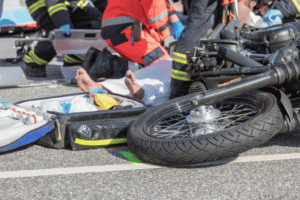


If you were hurt in a Las Vegas motorcycle crash, you may have already felt it: the insurance company started building a case against you before it looked at a shred of real evidence. Knowing how insurance companies blame motorcycle riders — and why they do it so fast — is the first step to stopping that blame from quietly gutting your claim.
Here’s the part they’re counting on you not to know. National crash research points the other way: in most motorcycle crashes involving another vehicle, the driver who hit the rider caused it. The blame aimed at you is a tactic, not a verdict — and in Nevada, it’s a tactic with a dollar figure attached.
The Truth About Who Causes Most Motorcycle Accidents
The stereotype says the biker was reckless. The data says otherwise. Federal crash studies going back decades have found that in roughly two-thirds of motorcycle crashes involving another vehicle, the other driver violated the motorcyclist’s right of way. The single most common pattern is a car turning left across the path of a rider going straight — the “I never even saw the motorcycle” collision.
That last phrase matters. “He came out of nowhere” is the most common thing at-fault drivers say, and it isn’t a defense — it’s an admission that the driver failed to look. Even federal safety agencies push back on the rider-fault myth, noting that failing to see an oncoming motorcycle is a leading cause of these crashes, not anything the rider did.
In Las Vegas, that plays out at the busiest corridors — left turns off the Strip, resort-driveway traffic on Las Vegas Boulevard, and lane changes on the I-15/US-95 interchange. Where and how your crash happened shapes who’s actually liable, which is exactly why the Las Vegas motor vehicle accident attorney team looks at the road, not the stereotype.
Why the Blame Sticks to Riders Anyway
If the data favors riders, why do insurers keep winning the blame game? Because they’re not arguing with the data — they’re leaning on a bias that was in the room before the crash ever happened.
Most people carry a quiet assumption that anyone on a motorcycle is a risk-taker: too fast, too aggressive, asking for it. Adjusters know jurors carry it too. So instead of proving the rider did something wrong, they simply suggest it and let the stereotype do the work. It’s cheap, it’s effective, and it costs the insurer nothing to try.
This is where Howard Injury Law sees the game differently than most firms. Glen Howard spent the early part of his career on the insurance-defense side, building these exact arguments against injured people. He knows how a rider’s gear, speed, and lane position get reframed into “fault” — because he used to be the one doing it. That inside view is the difference between a claim that absorbs the bias and one that dismantles it.
How Bias Turns Into Lost Money: Nevada’s Comparative Negligence Rule
Here’s why the blame isn’t just insulting — it’s expensive. Nevada follows a modified comparative negligence rule (NRS 41.141). You can recover compensation as long as you were 50% or less at fault, and whatever percentage of blame lands on you is subtracted from your recovery. Cross 51% and you recover nothing.
Read that again, because it explains everything the adjuster does. Every percentage point of fault they can pin on the rider is money they legally don’t have to pay. Shaving your claim from 0% to 30% fault isn’t about justice — it’s a 30% discount they hand themselves. That is the entire reason they push the “reckless rider” story so hard.
The reassuring flip side: being accused of partial fault does not end your Nevada claim. An adjuster’s opinion is not a legal ruling, and most injured riders sit well under the 50% line. If you want the full mechanics of how shared fault is split and how far it can be pushed, this breakdown of Nevada’s comparative negligence rule walks through it.
What the Adjuster Will Say — and How to Respond
The blame usually arrives disguised as a friendly phone call. Knowing what’s coming takes the pressure off. Here are the moves to expect and how to handle each one. None of this is legal advice for your specific case — every crash is different, and a quick conversation with an attorney is the safest way to apply it.
“We just need a quick recorded statement.”
This is the single most consequential moment, and it sounds like a formality. It isn’t. A recorded statement locks your words in permanently, and casual phrases you’d say to anyone — “I didn’t see the car,” “I was probably going the speed limit” — read as fault admissions in a claims file. You are almost never required to give the other driver’s insurer a recorded statement. Politely decline and get advice first. Here’s the deeper look at giving a recorded statement and why it matters so much.
“Were you lane-splitting or speeding?”
Expect them to assume both, usually with zero evidence. Lane splitting and lane filtering are illegal in Nevada under NRS 486.351, so if you were doing it, expect it to come up — but even then, you can still recover as long as you’re 50% or less at fault. Don’t guess your speed, don’t estimate distances, and don’t accept the premise. If you’re unsure what the law actually says, the rundown of traffic laws motorcyclists get blamed for is worth reading before you talk to anyone.
“Shouldn’t you have seen it coming?”
This one weaponizes rider training against you. The “12-second rule” — scanning the road about 12 seconds ahead — is a safety habit taught by the Motorcycle Safety Foundation. It is not a legal standard of fault. Failing to be superhuman is not negligence. A driver who turned left across your lane caused that crash; no amount of scanning obligates you to dodge someone who violated your right of way.
“We can settle this today.”
A fast offer, days after the crash, is not generosity — it’s a bet that you don’t yet know how hurt you are. Motorcycle injuries like soft-tissue damage, nerve injury, and concussions often surface or worsen over the following weeks. Once you sign a release, that door is closed for good. Don’t accept any number until you understand the full extent of your injuries.
How to Keep the Insurance Company From Writing Your Story
You don’t beat rider bias with arguments — you beat it with a record the adjuster can’t skip past. A few things protect your side while you focus on healing:
- Get medical care right away, even if you feel okay. Adrenaline hides serious injuries, and a prompt exam ties your injuries to the crash before an insurer can claim they came from somewhere else.
- Preserve the evidence that fades. Scene photos, the other vehicle’s position, witness names and numbers, and nearby traffic or business camera footage disappear within days. That evidence is what replaces the “reckless rider” assumption with facts.
- Say little to the adjuster. You can confirm basic facts without narrating the crash or speculating about fault.
- Get advice before you’re locked in. One conversation before you give a statement or accept an offer protects everything that comes after it.
Talk to a Lawyer Who Already Knows the Playbook
The reason biased blame works is that riders are handling it for the first time while the insurer has run this play thousands of times. That imbalance is the whole point — and it’s fixable.
Because Glen Howard built these arguments from the defense side, Howard Injury Law knows exactly how insurers manufacture rider fault and how to take it apart: scene evidence, vehicle black-box data, independent witnesses, and accident reconstruction when fault is contested. The firm works on contingency — no upfront cost, and no fee unless we win — so getting the insurance company’s version of your crash challenged costs you nothing to start. See how the firm fights blame off the rider on the motorcycle accident page.
Frequently Asked Questions
How do insurance companies decide who is at fault in a motorcycle accident?
Insurers weigh the police report, witness statements, physical evidence, and any traffic violations to assign each party a percentage of fault. In practice, the adjuster often starts from the assumption that the rider was at least partly responsible, then looks for evidence to support it. Because Nevada reduces your recovery by your share of fault (NRS 41.141), that percentage is worth real money to the insurer — which is why fault is so often contested in motorcycle claims. Their fault determination is not final or legally binding; it can be challenged with scene evidence, vehicle data, and independent witnesses that show what the other driver actually did.
What is the 12-second rule for motorcycle riders?
The 12-second rule is a safety technique taught in Motorcycle Safety Foundation courses: riders should scan the road roughly 12 seconds ahead so they can spot hazards early and react. At 30 mph that’s about a block ahead; at highway speed it’s much farther. It’s a defensive-riding habit, not a law and not a legal standard of fault. An insurance adjuster may imply you “should have seen it coming,” but failing to anticipate another driver’s illegal move — like a car turning left across your path — does not make the crash your fault. The driver who violated your right of way caused it.
What should I not tell my insurance company after a motorcycle crash?
Avoid guessing, speculating, or admitting anything. Don’t estimate your speed, don’t say “I’m fine” before you’ve been examined, and don’t accept blame with casual phrases like “I didn’t see them.” Stick to basic facts — where and when it happened, and that you’re seeking medical care. Never give the other driver’s insurer a recorded statement without talking to an attorney first, and don’t accept a settlement offer before you understand the full extent of your injuries. Under stress, ordinary comments can be reframed as fault admissions that permanently shrink your claim.
Is lane splitting legal in Nevada, and does it make a crash my fault?
No — lane splitting and lane filtering are both illegal in Nevada under NRS 486.351, and a 2026 effort to allow low-speed filtering did not become law. If you were splitting lanes when the crash happened, expect the insurer to raise it. But it doesn’t automatically make you at fault or bar your claim. Under Nevada’s comparative negligence rule, you can still recover as long as you were 50% or less responsible, with your recovery reduced by your share of fault. Whether it affects your case depends on the specific facts, so it’s worth reviewing with an attorney.

Injured and being blamed?
You don’t have to accept the insurance company’s version of what happened to you. A free, no-obligation case review with Howard Injury Law puts someone who knows the insurers’ playbook on your side — and Nevada’s filing deadline means the sooner you act, the more of your options stay open. Call (702) 331-5722 24/7 or contact us to find out what your claim is really worth.