


Search “average rollover accident settlement” and you’ll get a number — and that number is close to useless for your case. Rollover settlements range too widely for any single average to tell you what yours is worth, and the figures floating around online are usually built to make a fast, low offer look reasonable.
If you were hurt when your vehicle flipped in Las Vegas, what you actually need isn’t an average — it’s an honest read on what determines your settlement, why the insurance company’s first number is probably low, and how Nevada law shapes the final figure. That’s what this page covers.
Is there an average rollover accident settlement in Las Vegas?
Not a reliable one. Any “average” blends a moderate-injury case with a catastrophic one — a broken wrist that heals in months sits in the same math as a spinal cord injury that never does. Average the two and you get a number that describes neither.
That’s the problem with every rollover settlement average you’ll find online. Rollovers produce an unusually wide spread of outcomes, so the middle figure isn’t a realistic expectation — it’s a statistical accident. Worse, a quoted average tends to anchor you low. Once a number is in your head, a quick offer near it feels fair, even when your injuries are worth far more.
The useful question isn’t “what’s the average?” It’s “what sets the range for a rollover like mine?” In Nevada, a handful of specific factors do exactly that.
What actually determines a rollover settlement in Nevada
Instead of chasing an average, look at the factors that set the value of your specific claim. These are what a Las Vegas rollover accident lawyer actually works with when building your case.
The severity of your injuries
This is the single biggest driver of any rollover settlement. Moderate injuries that heal — soft tissue damage, a minor fracture — land in a lower range. Injuries that require surgery, leave permanent limitations, or need long-term care push the value up sharply.
Rollovers skew toward the severe end: traumatic brain injuries, spinal damage, and multiple fractures are common when a vehicle rotates and the roof takes load. The cost of future care — surgeries you haven’t had yet, therapy, lost earning capacity — is often the largest and most contested part of a serious claim, and it’s exactly the part insurers try to leave out. For a broader sense of how injury severity shapes value, the average car accident settlement in Las Vegas follows the same logic across all crash types.
Insurance coverage and policy limits
Here’s the ceiling nobody mentions. Nevada requires drivers to carry only 25/50/20 liability coverage — $25,000 per person, $50,000 per accident, $20,000 property damage. If the at-fault driver carries the state minimum, their policy caps at $25,000 per injured person, no matter how serious your injuries are.
That doesn’t mean your recovery stops there. Additional coverage can come from the at-fault driver’s higher limits, your own underinsured motorist (UM/UIM) coverage, or other responsible parties — a tire manufacturer or vehicle maker if a defect caused the rollover. But policy limits are often the practical ceiling on what’s collectible, which is why understanding Nevada’s minimum insurance requirements matters before you judge whether an offer is fair.
How much fault the insurer pins on you
Rollover fault is disputed more than any other crash type. When a single vehicle flips, insurers reach for “you overcorrected” or “you were speeding” — because shifting blame onto you directly lowers what they pay.
Under Nevada’s modified comparative negligence rule, your settlement is reduced by your share of fault, and you’re barred from recovering only if you’re found more than 50% responsible. So a finding that you were 20% at fault cuts a $100,000 value to $80,000 — not to zero. Every percentage point the insurer assigns you subtracts real money, which is why disputed liability car accident claims are worth fighting rather than accepting. Countering that blame is a core part of what your rollover claim is actually worth. Because fault turns on the specific facts, an honest review of your crash matters before you agree to any split.
Why the insurance company’s first offer is usually low
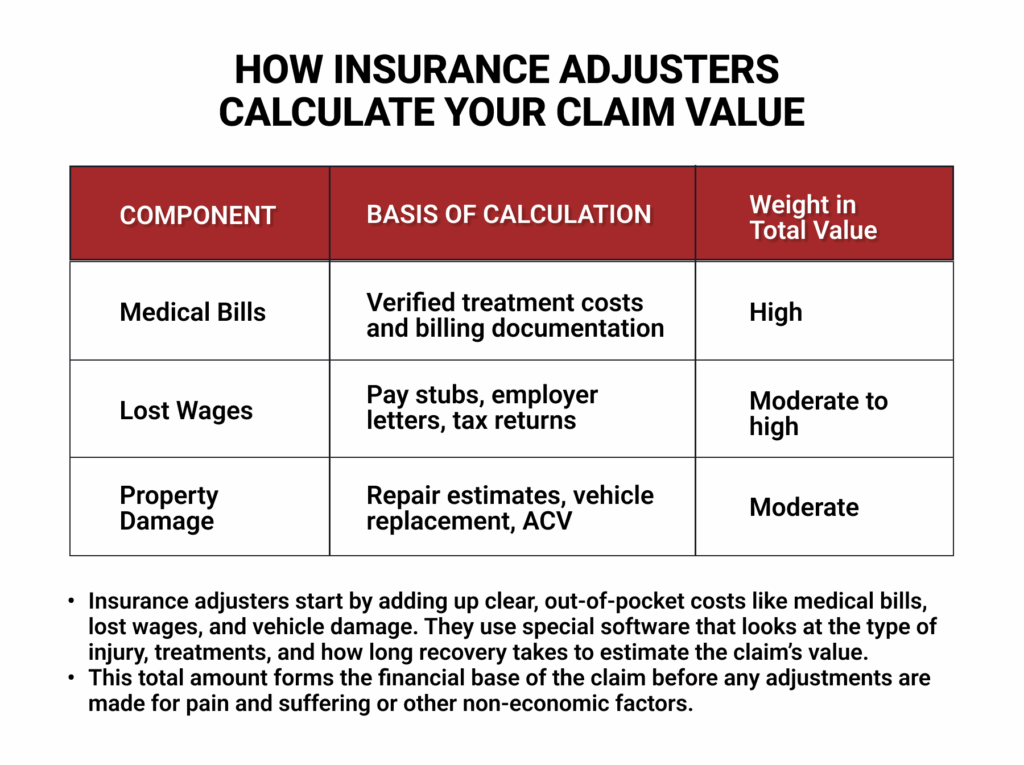
A fast settlement offer after a rollover is rarely a favor. It usually arrives before the full picture of your injuries is known — before you’ve finished treatment, before future care is scoped, before anyone has calculated lost earning capacity. Settle then, and you settle for less than the claim is worth.
The early offer also does quiet work for the insurer. It anchors your expectations low, and if you give a recorded statement first, your own words can be used to trim the number further. Once you accept and sign, the claim is closed. There’s no going back for more, even if a serious injury surfaces weeks later.
How to protect the value of your rollover settlement
You don’t need to become an expert — you need to avoid the moves that shrink a claim. A few matter most:
- Keep treating and document everything. Gaps in care become the insurer’s argument that you weren’t really hurt.
- Don’t accept an early offer or give a recorded statement before you understand your injuries and your rights.
- Preserve the evidence. Rollover proof — the vehicle, the tire, onboard data, scene measurements — disappears fast once the car is towed or scrapped.
- Get a professional case review before you sign anything. An honest valuation of your specific injuries, coverage, and fault picture is the only way to know if an offer is fair.
Frequently Asked Questions
What is the average payout for a rollover accident?
There’s no reliable average payout for a rollover accident, and any figure quoted without knowing your facts should be treated with caution. Rollover outcomes range from moderate to catastrophic, so a blended average describes no real case and often anchors your expectations below what your claim is worth. What matters is the combination of factors specific to you: the severity and permanence of your injuries, the total medical and future-care costs, the available insurance coverage, and how much fault the insurer tries to assign you. The most accurate number you can get is a case review that looks at those specifics rather than a statistic pulled from a national dataset.
How much can I get for a rollover accident in Las Vegas?
It depends on three things more than anything else: how badly you were hurt, how much insurance coverage is available, and how the fault question resolves. A rollover with permanent injuries, strong evidence of a defect or another driver’s negligence, and adequate coverage can be worth substantially more than one with moderate injuries and contested fault. Nevada lets you pursue compensation for medical bills, future care, lost income, and pain and suffering. Because policy limits can cap what’s collectible, part of the work is identifying every available source of coverage — the at-fault driver, your own UM/UIM policy, and any at-fault manufacturer.
How long does a rollover settlement take?
It varies widely, and rushing usually works against you. Straightforward claims can resolve in a few months, while serious rollover cases take longer — often because it’s wise to wait until you’ve reached maximum medical improvement before valuing future care. Disputed fault, multiple insurers, and litigation all extend the timeline. The general factors that stretch or shorten a case are covered in how long a car accident settlement takes in Nevada. The short version: a slower settlement that reflects your full injuries usually beats a fast one that doesn’t.
Should I accept the first settlement offer after a rollover?
Usually not. First offers tend to come early and low, before the full cost of a serious rollover injury is known — and once you accept, the claim is closed for good. That doesn’t mean every offer is unfair, but it does mean you should know what your claim is worth before you sign. A free case review costs nothing and tells you whether the number on the table reflects your injuries or just the insurer’s opening position.

Find out what your rollover claim is actually worth
If you’re staring at an offer and wondering whether it’s fair, the honest answer is that you can’t know from an average — only from the details of your own case. That’s what a review gives you.
Howard Injury Law was founded by attorney Glen Howard, who spent years on the insurance defense side before representing injured people. He knows how insurers value — and undervalue — rollover claims, because he used to build those valuations himself. On a case that hinges on severe injuries and disputed fault, that’s a real edge.
The firm works on contingency: no fee unless we win your case, and the case review is free. Because rollover evidence vanishes quickly, the most valuable step you can take right now is a quick call — before the proof of what your claim is worth is gone.
Call Howard Injury Law 24/7 at (702) 331-5722 for a free case review, or use the 24/7 web form. Bring the offer if you have one — we’ll tell you honestly what your rollover claim should be worth.