


Not every truck crash is the same, and a handful of them stand apart for how badly they hurt the people caught inside. The most dangerous truck accidents — underride collisions and head-on wrecks above all — cause the kind of injuries that change a life in a single second: traumatic brain damage, spinal cord damage, crushed limbs, and worse.
If you’re reading this after a crash on I-15 or anywhere across the Las Vegas valley, start with one fact: how severe your injuries are had almost nothing to do with you. It came down to physics. A fully loaded semi can weigh twenty times what your car does. Below is a plain breakdown of which truck crashes cause the most severe injuries in Nevada, why they do, and what that means for your ability to recover.
Why truck crashes cause far worse injuries than car crashes
Two cars of similar size crashing tend to hurt each other in similar ways. A truck versus a car is a different event entirely, because the two vehicles are nowhere near an even match.
A fully loaded tractor-trailer can legally weigh up to 80,000 pounds. A typical passenger car weighs around 4,000. That roughly 20-to-1 mismatch means the car absorbs almost all of the crash energy, while the truck often keeps moving. Add the height difference — a trailer sits far higher off the road than your hood or bumper — and the truck can strike a car above the exact zones engineers built to protect you.
The data shows who pays the price. In 2024, about 5,340 people died in large-truck crashes across the country, and 62% of them were people in other vehicles, not the truck occupants. Of the roughly 161,000 people injured in these crashes that year, 72% were in the other vehicle. Large trucks made up a small share of vehicles on the road but were involved in about one in seven traffic deaths. In a truck crash, the smaller vehicle almost always takes the worst of it — and that vulnerability is exactly why these cases deserve to be taken seriously.
Underride crashes: the deadliest configuration
If there is one truck crash that safety researchers point to as the most lethal, it’s the underride crash. These collisions are so destructive because they defeat nearly every safety feature in your car at once.
What is an underride crash?
An underride crash happens when a passenger vehicle slides underneath a truck’s trailer — either from behind (rear underride) or into its side (side underride). Because the trailer sits so high, your car doesn’t hit a bumper. It slides beneath the trailer, and the truck’s frame strikes the car at windshield level instead.
That changes everything. Your bumper, crumple zones, and airbag sensors never engage, because the impact happens above them. In the worst cases the trailer shears into the passenger compartment itself. The result is catastrophic head, neck, and chest trauma — injuries that would have been survivable in an ordinary collision.
Federal rules require most trailers to carry a rear underride guard, and the standard was strengthened in recent years. But there is still no federal requirement for side underride guards, even though side underride can be just as deadly. Hundreds of people are killed in underride crashes in the U.S. every year, and safety experts believe the true number is undercounted, because many police crash reports don’t even have a field to record underride. When a guard was missing, damaged, or poorly maintained, responsibility can extend past the driver to the carrier and sometimes the trailer’s manufacturer.
Head-on truck collisions: maximum combined force
A head-on collision with a commercial truck concentrates the most force of any crash type, because both vehicles’ momentum slams together at the point of impact.
These happen when a truck crosses the centerline or enters oncoming traffic — often tied to fatigue, impairment, distraction, or a driver losing control on a curve or grade. When a 4,000-pound car meets a loaded rig coming the other way, the combined energy is enormous, and survivability drops fast. Head-on truck wrecks are a leading cause of fatal and life-altering injuries for exactly this reason: there’s simply nowhere for the energy to go except into the smaller vehicle and the people inside it.
Rollovers, jackknifes, and multi-vehicle pileups: crushing and secondary impacts
Some of the worst truck crashes don’t start with a direct hit on your car — they start with the truck losing control.
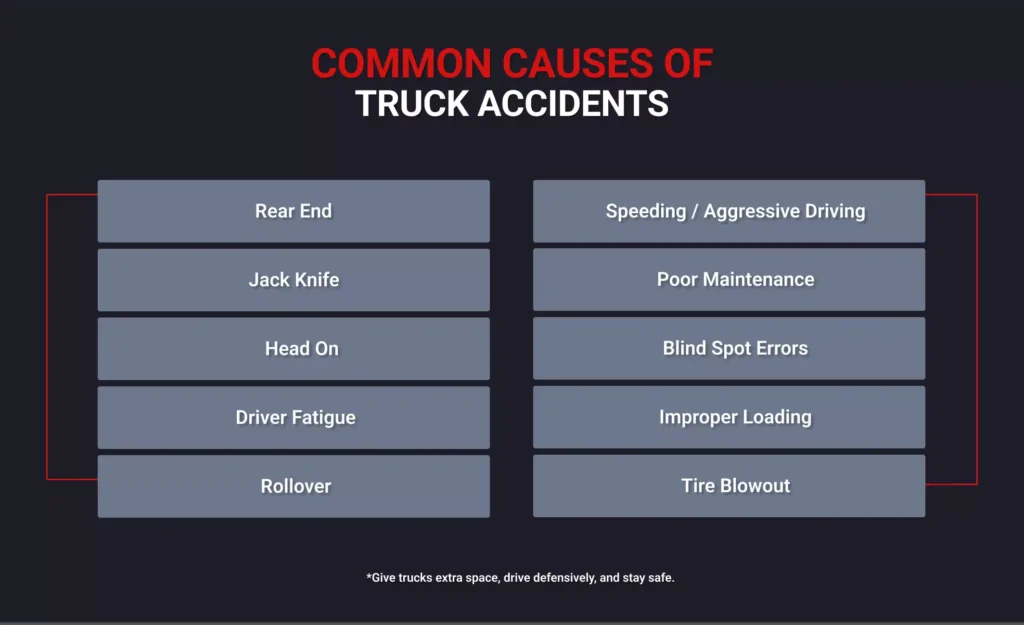
In a rollover, a truck tips onto its side or roof and can crush whatever is beside it. In a jackknife, the trailer swings out of line with the cab and folds toward a V-shape, sweeping across lanes. Both frequently block multiple lanes and trigger chain-reaction pileups, where the first impact is only the beginning and secondary collisions pile on more harm.
This matters in Las Vegas because so much freight moves through the valley. I-15 is the main trucking artery between Southern California and Salt Lake City, and it funnels heavy commercial traffic straight through the Spaghetti Bowl, where I-15 and US-95 tangle together. When a big rig rolls or jackknifes on a corridor that busy, the danger spreads to every car around it.
The catastrophic injuries these crashes cause
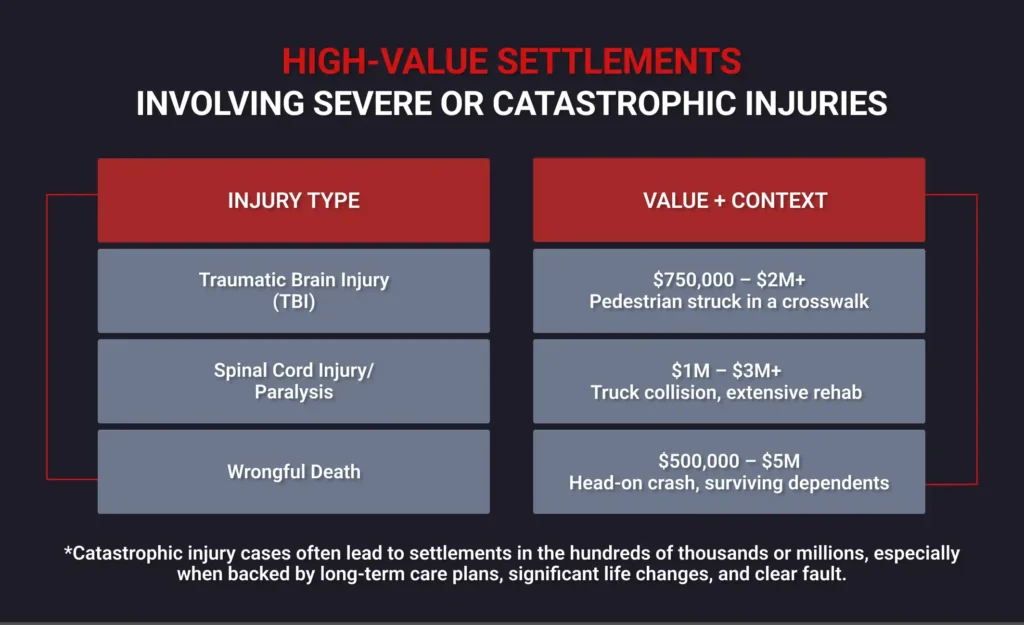
The crash types above tend to produce the same short list of severe injuries — the ones that require surgery, long recoveries, and sometimes permanent care:
- Traumatic brain injuries (TBIs) — from direct impact or the violent whipping motion of a high-force crash. Learn more about traumatic brain injuries after a truck crash.
- Spinal cord damage — which can lead to partial or full paralysis. These are among the highest-value and most complex claims; see spinal cord injury settlements in Nevada.
- Crush injuries and amputations — when a passenger vehicle’s cabin collapses inward, as it often does in underride and rollover crashes.
- Internal organ damage — caused by the extreme deceleration forces in a high-speed truck impact, and dangerous precisely because it isn’t always visible right away.
That last point deserves emphasis. Serious internal and brain injuries can take hours or days to show symptoms, and adrenaline masks a lot at the scene. If you walked away feeling “okay,” get checked anyway — here’s why some truck accident injuries surface days later. Every injury and every crash is different, so treat this as general information, not a diagnosis or legal advice for your specific situation.
Why severe truck-crash cases are handled differently
A catastrophic truck crash is not a bigger version of a fender-bender. It’s a different kind of case, and the difference decides how much an injured person can actually recover.
Commercial trucks run under federal rules — the FMCSA regulations covering driver hours, maintenance, and inspections — and most carry an electronic logging device and event data recorder (“black box”) that can show speed, braking, and hours behind the wheel. That evidence is powerful, and it can disappear fast: logs get overwritten, trucks get repaired, and carriers move quickly to protect themselves. There can also be several parties on the hook — the driver, the trucking company, a maintenance contractor, or a parts manufacturer — which is why how our trucking team investigates these cases starts with preserving that evidence early.
This is also where Howard Injury Law’s background matters. Founder Glen Howard spent years as an insurance defense attorney before representing injured people, so he knows how carriers and their insurers value — and fight — severe-injury claims. That perspective shapes how the firm handles any motor vehicle crash claim, and it’s especially valuable when the injuries are life-altering and the money on the table is large.
Frequently Asked Questions
What is the most dangerous type of truck accident?
Underride crashes are widely considered the most dangerous, followed closely by head-on collisions. Underride is so lethal because the car slides beneath the trailer and the impact bypasses your bumper, crumple zones, and airbags entirely, striking at windshield level and causing severe head and neck trauma. Head-on truck collisions are devastating for a different reason — the combined momentum of both vehicles concentrates enormous force on the smaller car. Rollovers and jackknifes round out the list, mainly because they crush adjacent vehicles and trigger multi-car pileups. All four produce a similar pattern of catastrophic, sometimes fatal, injuries.
What are the most common injuries in a truck accident?
The most common severe injuries are traumatic brain injuries, spinal cord damage (which can cause paralysis), crush injuries and amputations, and internal organ damage. Broken bones, herniated discs, and whiplash-type neck injuries are also frequent. What sets truck-crash injuries apart is their severity — the weight and height of a commercial truck means the smaller vehicle absorbs forces a car simply isn’t built to withstand. Some of these injuries, especially brain bleeds and internal damage, may not show clear symptoms for hours or days, so prompt medical evaluation matters even if you feel fine at the scene.
What trucking company has the highest accident rate?
There’s no single company that reliably holds that title — crash and violation numbers shift year to year, and a large carrier’s size inflates its raw totals. What matters far more for your case is the record of the specific carrier involved in your crash. The federal government tracks that. Through the FMCSA’s SAFER and Safety Measurement System, we can pull a motor carrier’s crash history, roadside inspection results, and safety violations, then use it as evidence. A documented pattern of hours-of-service or maintenance violations can meaningfully strengthen an injury claim.
Are truck accident injuries always obvious right away?
No — and that’s one of the biggest risks after a serious crash. Adrenaline can mask pain at the scene, and some of the most dangerous injuries, including traumatic brain injuries and internal bleeding, may take hours or days to produce symptoms. People sometimes decline treatment, feel worse the next morning, and unknowingly hurt both their health and their claim. Get a medical evaluation as soon as possible after any truck crash, keep every record, and don’t give a recorded statement to the trucking company’s insurer before you understand the full extent of your injuries.

Talk to a Las Vegas truck accident attorney before the evidence is gone
If a truck crash left you or someone you love with a serious injury, you’re likely trying to make sense of something that happened in seconds and will affect years. You don’t have to figure out the legal side alone — and you shouldn’t wait, because the black-box data, driver logs, and physical evidence that prove what really happened can vanish within days.
Howard Injury Law offers a free, no-pressure consultation to look at what happened, explain your options in plain terms, and tell you honestly whether you have a case. There’s no fee unless we win. Reach out through our contact page or call (702) 331-5722 to speak with a Nevada attorney who knows how the other side thinks.