


If you’re weighing a personal injury claim in Las Vegas, one worry usually sits underneath all the others: what are the chances of winning a personal injury lawsuit, and is it even worth putting yourself through it? The honest answer is more encouraging than the fear in your head — most valid claims never see a courtroom, and the people who recover full compensation are almost always the ones who got the right help early.
Here’s what actually affects your odds in Nevada, what the numbers do and don’t tell you, and how to find out where your own case stands without spending a dollar.

The Real Odds: Most Cases Settle, Few Ever Reach a Courtroom
Start by throwing out the courtroom-drama version of “winning.” For most injured people, winning means getting the compensation that covers their medical bills, lost income, and the disruption to their life — and that almost always happens through a settlement, not a jury verdict.
National research consistently shows that the large majority of personal injury cases — commonly estimated at 90 to 95 percent or more — resolve through settlement before trial. Of the small share that do go all the way to trial, plaintiffs win roughly 50 to 60 percent of the time, depending heavily on the type of case and the strength of the evidence.
A few honest caveats matter here. These figures come from national studies (largely older U.S. Department of Justice data), not from a Nevada scorecard, and no single source tracks every settlement precisely. They describe broad tendencies — not a prediction for your case. What they do tell you is useful: the system is built to resolve claims by agreement, and a strong, well-documented case rarely needs a trial to succeed.
Success Rates by Case Type
Not every injury claim carries the same odds. The category your case falls into shifts the picture before anyone looks at your specific facts.
- Motor vehicle accidents tend to have the clearest liability — a driver who ran a red light or rear-ended you leaves little room for argument — and plaintiffs historically win these at trial more often than average.
- Slip-and-fall and premises cases are tougher. You have to prove not just that a hazard existed, but that the property owner knew or should have known about it and failed to fix it.
- Medical malpractice is the hardest category. These cases hinge on expert testimony and complex standards of care, and plaintiff win rates at trial have historically been much lower.
Treat these as general patterns, not verdicts on your claim. A well-built slip-and-fall case with clear evidence can outperform a sloppy car accident case every time. The category sets the starting line; your facts and your preparation decide the finish.
What Actually Affects Your Chances of Winning
Four things move your odds more than anything else. Every one of them is at least partly within your control.
Clear Liability
The stronger the proof that someone else caused your injury, the better your position. A driver cited for running a light, a store that ignored a spill for an hour, a landlord who left a stairway broken — clear fault is the foundation everything else is built on.
Strong Evidence
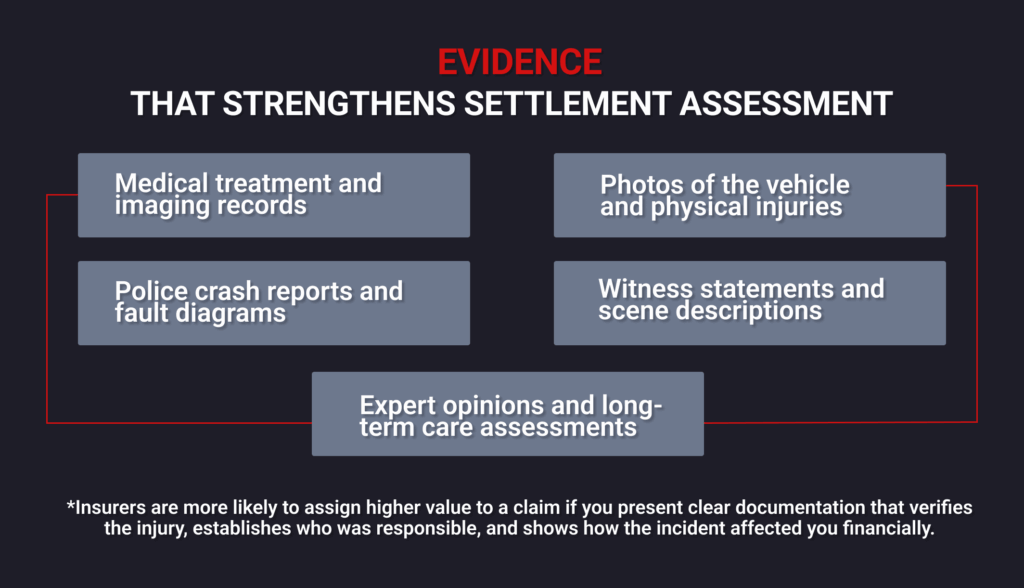
Cases are won on documentation. Medical records that tie your injuries to the accident, the police or incident report, photos, and witness statements do the heavy lifting. This is also why prompt medical care matters so much: a gap between the accident and your first treatment gives an insurer room to argue you weren’t really hurt.
Shared Fault and Nevada’s 51% Rule
Nevada follows a modified comparative negligence rule under NRS 41.141. In plain terms: if you share some of the blame, your compensation is reduced by your percentage of fault — but you can still recover as long as your share is 50 percent or less. Cross the line to 51 percent or more, and you’re barred from recovering at all.
That’s exactly why insurance adjusters work so hard to pin fault on you. Every percentage point they shift onto you is money they keep. Being partly at fault does not automatically end your claim, but how that fault gets argued can change everything — which is a big part of what an experienced attorney is fighting over. (Every case is different, so treat this as general Nevada law, not advice on your specific situation.)
Whether You Have a Lawyer
Insurance companies settle for less with unrepresented people — and they know it. A lawyer changes how seriously your claim is taken, keeps you from the common traps in dealing with the insurance adjuster, and builds the case so that the number on the table reflects what you’ve actually lost.
Is It Worth Suing for a Personal Injury?
For most people the real calculation is: will the outcome justify the effort? A few honest questions answer it. How serious are your injuries and how long is recovery? How clear is the other side’s fault? Are there real damages — medical bills, missed work, lasting effects — to recover?
When injuries are minor and quickly healed, a claim may not be worth it. When you’re facing significant treatment, time off work, or a lasting impact, pursuing compensation usually is — especially since the cost of finding out is nothing. If you want a realistic sense of the numbers before deciding, start with what your case may be worth rather than an “average settlement” figure off the internet, which is close to useless for any individual case.
How Howard Injury Law Changes the Math
The single biggest factor you can control is who’s in your corner. This is where Howard Injury Law is built differently.
Attorney Glen Howard began his career defending insurance companies before he started fighting them. He knows exactly how the other side evaluates, delays, and discounts claims — because he used to do it. That perspective is difficult to teach and hard to counter, and it shapes how every case is valued and negotiated. Over more than 1,000 cases, the firm has recovered more than $75 million for injured Nevadans.
You also work directly with your attorney, not a rotating cast of case managers. And because the firm works on contingency, there’s no fee unless you win — no retainer, no hourly bills, nothing out of pocket while your case moves forward. If cost is the reason you’ve been hesitating, that’s the barrier removed. Here’s what happens when you call, so there are no surprises.

Frequently Asked Questions
How Much Are Most Personal Injury Settlements?
There’s no reliable “average,” and any site quoting a single number is guessing. Settlement value depends on the specifics of your case: the severity of your injuries, your total medical costs, lost income and future earning capacity, how clearly the other party is at fault, and the available insurance coverage. Two people in similar crashes can recover very different amounts based on those factors alone. A lowball figure early from an adjuster is a starting point, not your claim’s worth. The most accurate way to understand your range is to have a Las Vegas personal injury lawyer review the details — not to anchor to an internet average that ignores everything specific to you.
At What Point Do Most Personal Injury Cases Settle?
It varies, but a common pattern is that serious cases settle after you’ve finished or substantially progressed through medical treatment — because only then is the full extent of your injuries clear. Settling too early, before you know whether you need ongoing care, is one of the most expensive mistakes injured people make. Some cases resolve in a few months; others take a year or more, especially when liability is disputed or injuries are severe. Filing a lawsuit doesn’t mean you’re going to trial — it often pushes an insurer toward a fair settlement. The right timing depends on your recovery, not the insurer’s schedule.
What Happens to My Case if I Was Partly at Fault?
You can still recover, as long as your share of the blame is 50 percent or less under Nevada’s comparative negligence rule. Your compensation is reduced by your fault percentage — so if you’re found 20 percent responsible, you receive 80 percent of your damages. Only when your share reaches 51 percent or more are you barred entirely. Because so much money rides on that percentage, insurers push hard to assign you more blame than you deserve. Having someone who can push back with evidence often makes the difference between a reduced recovery and no recovery. This is general Nevada law, so talk to an attorney about how it applies to your situation.
How Long Do I Have to File a Personal Injury Lawsuit in Nevada?
Generally, you have two years from the date of the injury to file a personal injury lawsuit in Nevada under NRS 11.190. Miss that deadline and a court can dismiss even a strong case. There are exceptions that can shorten or extend the clock — for example, when an injury isn’t discovered right away, or when a government entity is involved — so the safe move is never to assume you have plenty of time. Evidence also fades fast, so acting early protects your claim in more ways than one. You can read more about Nevada’s statute of limitations and how the deadlines work.
Do You Have a Case? Find Out for Free
If the thing holding you back is the fear of going through all this and still losing, get a straight answer before you decide anything. A free consultation with a Las Vegas personal injury attorney will tell you whether your claim is solid, roughly what it may be worth, and what the next step looks like — with no obligation and no cost to find out.
Call Howard Injury Law at (702) 331-5722 or request a free case review. You’ll talk through what happened, get an honest read on your odds from someone who knows how insurance companies think, and leave knowing where you stand. There’s no fee unless we win — so the only thing it costs to know is a phone call.