



You’ve decided to hire a personal injury attorney. The retainer agreement is in front of you. It’s a legal document — dense, formal, and full of terms that don’t come up in everyday conversation. Most people sign it quickly, but understanding how to read a personal injury contingency fee agreement before you sign protects you from surprises and gives you a clear picture of what your case will actually put in your pocket.
Some of those people are surprised at settlement when the numbers don’t look like what they expected. So, here’s exactly what to look for, what every key provision means, and the questions to ask before you commit.
What a Contingency Fee Agreement Is
A contingency fee agreement is the contract between you and your personal injury attorney that governs how the attorney gets paid. In Nevada, personal injury attorneys work on contingency — meaning their fee is a percentage of your recovery, paid only if your case produces compensation.
The agreement is required to be in writing under Nevada Rules of Professional Conduct Rule 1.5. It must be signed by the client before work begins and must clearly state the method for determining the fee. If an attorney asks you to proceed without a written agreement, that’s a significant red flag worth noting before you sign anything.
The agreement governs the entire financial relationship — the fee percentage, how case expenses are handled, what happens if the case doesn’t win, who has authority to settle, and what happens if you or the attorney terminate the relationship mid-case. Every one of those provisions is negotiable and every one of them affects how much money you ultimately receive.
The Fee Percentage — What to Look For
The first and most prominent number in any contingency fee agreement is the percentage. This is the portion of your recovery the attorney collects as their fee.
The Sliding Scale Structure
Most personal injury contingency fee agreements in Nevada use a sliding scale — the percentage increases depending on how far the case progresses before resolving.
A common structure looks like this: one percentage if the case settles before a lawsuit is filed, a higher percentage if a lawsuit is filed and the case goes into litigation, and the highest percentage if the case proceeds to trial. The rationale is that each stage requires more attorney time, preparation, and expense — so the fee reflects that increased investment.
What matters for you is understanding the full schedule — not just the initial rate. Ask for every tier in writing. A one-percentage-point difference on a significant settlement is a meaningful dollar amount. Understanding when and why the percentage changes helps you make informed decisions throughout your case.
Why the Percentage Alone Doesn’t Tell You Enough
The percentage matters — but it’s only part of the equation. The same percentage applied to the gross settlement produces a different result than the same percentage applied to the net settlement after expenses. Whether the fee is calculated on gross or net is often more financially significant than the specific percentage itself.
More on that below.
Gross vs Net — The Most Important Clause in the Agreement
This is the provision that most frequently surprises clients at settlement — and it’s one of the least discussed during the initial consultation.
What Gross Settlement Means
If your agreement states that the contingency fee is calculated on the gross settlement, the attorney’s percentage comes off the total recovery before any deductions. On a $100,000 settlement with a 33% contingency fee, the attorney collects $33,000 from the gross amount. Case costs and medical liens are then paid from the remaining $67,000.
What Net Settlement Means
If your agreement states that the contingency fee is calculated on the net settlement — meaning after case costs are deducted — the calculation works differently. On a $100,000 settlement with $10,000 in case costs and a 33% fee on the net amount, the fee is calculated on $90,000, producing a fee of $29,700. You keep more.
The difference between gross and net calculation can be significant on cases with substantial litigation expenses. Ask specifically which method applies before you sign. Get the answer in writing. If the agreement is ambiguous, ask for clarification in writing before proceeding.
Case Costs and Expenses — What They Are and Who Pays Them
Case costs are the out-of-pocket expenses of litigating your case. They’re separate from the attorney fee and they come out of your recovery at settlement.
What Case Costs Include
Filing fees with the court, medical record retrieval fees, expert witness fees, accident reconstruction costs, deposition expenses, investigator fees, and demonstrative exhibit costs are all examples of case costs that accumulate throughout litigation.
On a straightforward car accident case, costs might be modest. On a complex case involving multiple experts, significant litigation, and extensive discovery, costs can be substantial.
How Case Costs Are Typically Handled
Most Nevada personal injury firms advance case costs throughout the case — meaning you don’t pay them as they arise. The firm carries those costs as an investment in the outcome. At settlement, the advanced costs are reimbursed from your recovery before you receive your net share.
Your agreement should specify this clearly. Look for language indicating that the firm will advance costs and that reimbursement comes from the settlement — not from you directly regardless of outcome.
The Critical Question — What Happens to Costs If You Lose?
This is one of the most important and least discussed provisions in a contingency fee agreement. If your case doesn’t produce a recovery, are you responsible for the case costs the firm advanced?
Some agreements specify that costs are forgiven if the case doesn’t win — true no financial risk for the client. Others require reimbursement of advanced costs regardless of outcome. The language matters and varies between firms.
Ask directly before you sign: if my case doesn’t produce a recovery, am I responsible for the costs advanced by the firm? Read the agreement carefully for this provision. For more on how the no win no fee model works in Nevada and what it actually covers, read our guide on no win no fee lawyers LV.
Medical Liens — How They Interact With Your Settlement
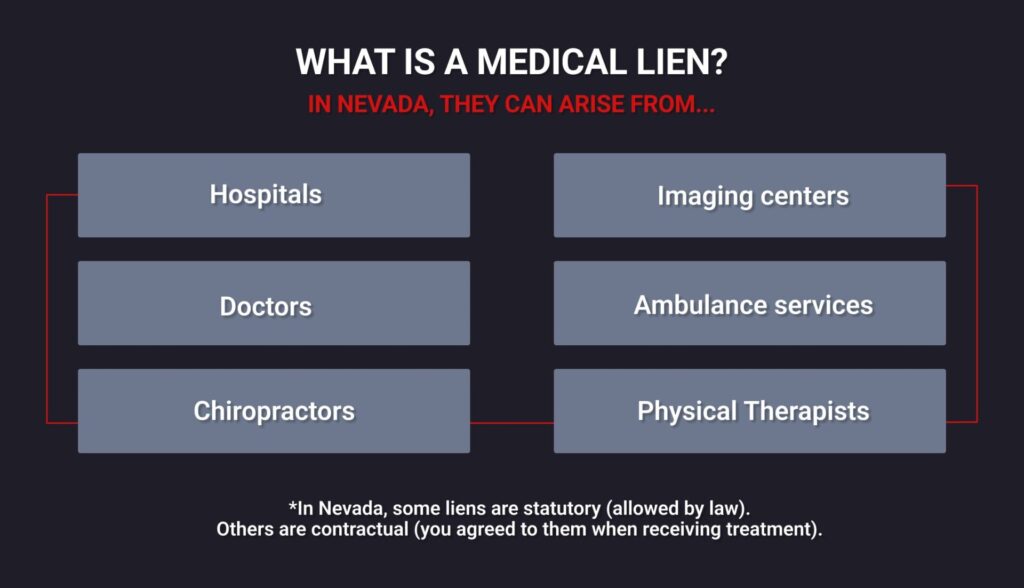
If you received medical treatment on a lien — meaning the provider agreed to be paid from your settlement rather than upfront — those lien amounts are also paid from your recovery at settlement.
How the Math Works at Settlement
At settlement, your attorney receives the gross check. From that, the contingency fee is deducted. Case costs are reimbursed. Medical liens are paid. What remains is your net recovery.
The order of operations in this calculation matters. An agreement that deducts the contingency fee from gross before paying costs and liens produces a different net result than one that deducts costs first and calculates the fee on the remainder.
Lien Negotiation — An Often-Overlooked Benefit
Medical liens are not fixed. Your attorney has the ability to negotiate lien amounts with providers at settlement — and experienced personal injury attorneys routinely reduce liens significantly. That negotiation directly increases your net recovery.
When reviewing a contingency fee agreement, confirm that lien negotiation is a service the firm provides as part of representation — not an add-on that carries additional fees. For a full explanation of how medical liens work and how they’re negotiated, read our guide on how medical liens work in Nevada personal injury cases.
Who Has Final Authority to Settle
Your contingency fee agreement should clearly state that the decision to accept or reject any settlement offer belongs to you — not to your attorney.
Under Nevada Rules of Professional Conduct, an attorney cannot settle a case without the client’s informed consent. No matter what the fee agreement says, that right is yours. But some agreements contain language that can create confusion about authority or pressure toward accepting offers.
Look for explicit language confirming your right to reject settlement offers. If an attorney ever pressures you to accept an offer over your objection, that’s a conduct concern regardless of what the agreement says.
Your attorney’s role is to give you their professional assessment of any offer — whether it reflects fair value, what the risks of rejecting it are, and what they recommend. The final decision is always yours.
What Happens If You Terminate the Attorney Mid-Case
Life happens. Representation relationships sometimes end before a case does — either because you decide to change attorneys or because the firm withdraws. Your contingency fee agreement should address this.
If You Fire Your Attorney
When a client terminates an attorney in the middle of a personal injury case, the departing attorney typically has a right to recover fees for work already performed. This is usually handled as a lien on the eventual recovery — meaning the first attorney gets compensated from the settlement even though a different attorney closes the case.
The specific terms vary. Some agreements specify a quantum meruit basis — reasonable value of services rendered. Others specify a proportional share of the contingency fee based on work completed. Read this provision before signing and understand what your financial exposure is if you decide to change representation.
This doesn’t mean you’re locked in. You always have the right to change attorneys in Nevada. It means understanding what the cost of that change looks like before you need to make it.
If the Attorney Withdraws
Firms sometimes withdraw from cases — due to conflicts of interest, changed circumstances, or if the case develops in a way that makes representation impractical. The agreement should address what happens to advanced costs and fees in this scenario.
The Closing Statement — What You Should Receive at Settlement
Before you sign any settlement release, your attorney should provide a complete closing statement itemizing every dollar — the gross recovery, the attorney fee, every cost deducted, every lien paid, and your net recovery.
This document is your right. It converts the fee agreement’s abstract provisions into the actual numbers of your specific case. Review it carefully before signing the release. The release is permanent — once signed, your claim is closed.
If any number on the closing statement is unclear or doesn’t match your understanding of the agreement, ask before you sign. A reputable attorney walks through the closing statement completely and answers every question before requesting your signature.
The Questions to Ask Before You Sign Any Contingency Fee Agreement
After reading the agreement, these are the specific questions that ensure you have the complete picture:
Is the fee calculated on the gross settlement or the net settlement after costs?
What is the full sliding scale — what percentage applies at each stage of the case?
Who advances case costs — the firm or the client as they arise?
If my case doesn’t produce a recovery, am I responsible for case costs?
Does the fee change if we go to trial versus settle before litigation?
What does the agreement say about my right to reject settlement offers?
What happens to fees if I decide to change attorneys mid-case?
Will I receive a full closing statement before signing the settlement release?
A firm that answers all of these questions directly and puts the answers in writing before you sign is a firm operating with complete transparency. For more on what to evaluate during any attorney consultation, read our guides on questions to ask during a personal injury consultation and red flags when hiring a personal injury lawyer.

Frequently Asked Questions
Is the contingency fee percentage negotiable?
In some situations, yes — particularly on high-value or clear-liability cases where the firm’s risk is lower. It’s always appropriate to ask. A firm that refuses to discuss terms at all is worth being cautious about. What matters most is understanding the complete financial picture — percentage, gross vs net, costs — rather than focusing only on the headline rate.
What does the average contingency fee look like in Nevada?
Rather than cite specific numbers, the honest answer is that percentages vary by firm and by case stage. What you’re looking for is the full schedule — not just the initial rate — and clarity on whether the fee applies to gross or net recovery. A free consultation with Howard Injury Law covers the complete fee structure before you make any commitment.
Can I see a sample agreement before the consultation?
Yes — asking to review the fee agreement structure before your consultation is completely reasonable. Any firm worth hiring provides this without hesitation.
Who decides if we go to trial vs settle?
You do. Your attorney advises. The decision to accept or reject any settlement offer belongs to the client under Nevada Rules of Professional Conduct. That right cannot be waived in a fee agreement.
Read It Before You Sign It
A personal injury contingency fee agreement is a legal contract that governs one of the most significant financial relationships of your case. Reading it — actually understanding the sliding scale, the gross vs net calculation, the cost provisions, and the termination terms — is not overcaution. It’s basic protection.
The numbers in that agreement are the difference between a settlement that feels fair and one that leaves you wondering where the money went.
Howard Injury Law walks through the complete fee structure at every free consultation — before you sign anything, before you commit. Call (702) 331-5722 or contact us here. Available 24/7.