


Yes, you can legally settle a car accident claim in Nevada without a lawyer. No law requires an attorney to negotiate with an insurance company, and minor claims get resolved that way every day across Las Vegas. So the real question isn’t whether you can settle on your own — it’s whether you need a lawyer for your car accident settlement to walk away with more, or whether this is one of the cases you can fairly handle yourself.
The honest answer depends on your specific crash. Below is a straight breakdown of when going solo is fine, when it quietly costs you money, and how to tell which situation you’re in before you sign anything.
You can settle without a lawyer — but should you?
Settling a claim yourself means dealing directly with the at-fault driver’s insurance adjuster: you submit your damages, they make an offer, and you negotiate until you agree on a number. For a clean, low-stakes crash, that process can work.
The catch is that the adjuster does this for a living and you don’t. Their job is to close your Las Vegas car accident claim for as little as possible, and a first offer is almost never their best one. Whether that matters comes down to how much is actually at stake in your case.
When handling your own car accident claim makes sense
Some crashes genuinely don’t need an attorney. Handling it yourself is reasonable when most of these are true:
- Property damage only, or a minor injury that fully healed — no ongoing treatment, no lasting symptoms.
- Fault is clear and undisputed — the other driver was plainly at fault and their insurer isn’t fighting it.
- Your medical bills are low and finished — you know the full cost because treatment is done.
- The offer already covers your real losses — your out-of-pocket costs, lost wages, and vehicle repair are fully accounted for.
If a rear-end tap in a Summerlin parking lot left you with a sore neck for a week and a repair estimate, and the insurer offers a number that covers it, you may not need a lawyer at all. Take the fair offer and move on.
When going without a lawyer quietly costs you more
The trouble is that the cases people think are simple often aren’t. Going it alone tends to backfire when any of these are in play:
- You needed real medical treatment. Soft-tissue injuries, a herniated disc, or a concussion can generate bills and future care that a quick settlement won’t cover — and once you sign a release, you can’t reopen the claim if symptoms worsen.
- Fault is disputed or shared. Nevada uses modified comparative negligence: you can still recover if you’re 50% or less at fault, but your payout drops by your share of blame, and you’re barred entirely if you’re found more at fault than the other driver. Adjusters push blame onto you precisely because it shrinks what they owe.
- There are medical liens. Health insurers and providers can claim a chunk of your settlement. Handle it wrong and money you thought was yours disappears.
- The offer feels low and you’re not sure why. First offers usually are low. Without knowing what your case is actually worth, you have no baseline to push back from.
- The driver was uninsured or underinsured. These claims get complicated fast and often involve your own policy.
- The two-year clock is running. In Nevada, you generally have two years from the crash to file a lawsuit for your injuries. Negotiating with an insurer does not pause that deadline — if talks drag and the clock runs out, you lose your leverage entirely.
How to negotiate a car accident claim without a lawyer in Nevada
If your crash falls on the DIY-friendly side and you want to handle it yourself, protect yourself with a few basics:
- Document everything. Photos, the police report, medical records, repair estimates, and a log of missed work. Your claim is only as strong as your proof.
- Know your full damages before you talk numbers. Add up bills, lost wages, and out-of-pocket costs. Don’t negotiate until treatment is done — you can’t un-sign a release later.
- Never accept the first offer, and be careful on recorded calls. Adjusters may ask for a recorded statement early; anything you say can be used to reduce your payout.
- Get every agreement in writing. A verbal number means nothing until it’s documented.
- Watch the two-year deadline. If you’re anywhere near it and haven’t settled, stop negotiating solo and get advice.
If you want the deeper playbook on countering lowball offers, our guide on getting the best possible settlement walks through the tactics that move an adjuster’s number up.
“How much will I get from a $50,000 settlement?”
This is where a lot of people who settle alone get surprised. A $50,000 settlement is not $50,000 in your pocket. It’s a gross number that gets reduced by unpaid medical bills, health-insurance liens, and any provider balances before you see a dime.
Say $50,000 comes in, but you owe $18,000 in medical bills and a $6,000 lien. Handle that alone and you might net around $26,000. A lawyer’s job includes negotiating those bills and liens down — often enough that your take-home rises even after the contingency fee comes out. That’s the piece the “why pay a lawyer” math usually misses: the comparison that matters is your net after fees, not the headline number.
Policy limits matter too. Nevada only requires drivers to carry $25,000 in bodily injury coverage per person, so if your injuries are serious and the at-fault driver carries the minimum, the available money may be capped no matter how strong your case is — which is exactly when experience finding other coverage sources pays off. For how the full valuation works, see what your case is actually worth.
Do I need a lawyer, or can I settle this myself?
Here’s the clean test: if your injuries are minor and healed, fault is clear, and the offer covers your real losses — you can likely settle without a lawyer. If any of those is shaky, an attorney usually changes the outcome enough to more than cover the fee.
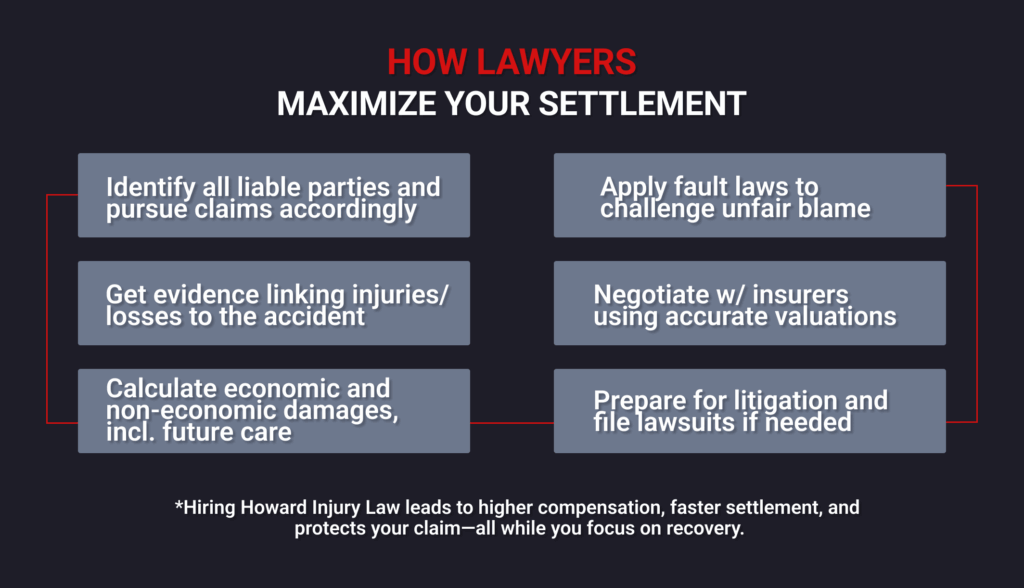
What a lawyer actually changes is leverage. At Howard Injury Law, founder Glen Howard spent years as an insurance defense attorney — he built the same claims the adjuster is now running on you, so he knows exactly where their offers have room. That background turns into pressure on disputed fault, negotiated-down liens, and a credible threat of trial that a self-represented claimant simply can’t put on the table.
And it costs nothing up front. HIL works on contingency — no fee unless we win — so comparing “settle alone” against “hire a lawyer” is really comparing two net numbers, not paying for the privilege of asking.
Frequently Asked Questions
Can I sue for emotional distress in Nevada?
In many cases, yes. If you were physically injured in the crash, emotional distress — anxiety, sleep loss, fear of driving — is generally recoverable as part of your pain and suffering damages. Nevada also recognizes emotional distress claims in narrower situations, but the rules get technical fast. If your crash left a real psychological toll, it’s worth understanding how emotional distress claims and pain and suffering after a crash are valued before you accept an offer that ignores them. Every case is different, so treat this as general information and confirm your specifics with an attorney.
Can I still settle if I was partly at fault for the crash?
Usually, yes. Nevada follows modified comparative negligence, so you can still recover as long as you were 50% or less at fault. Your settlement is reduced by your share of blame — if you’re found 20% at fault, your payout drops by 20% — and you’re cut off entirely only if you were more at fault than the other driver. This is exactly why adjusters try to pin extra blame on you: every percentage point they shift lowers what they pay. If fault is being disputed in your case, that’s one of the clearest signs it’s worth having a lawyer review the offer.
Is it worth getting a lawyer for a minor car accident in Las Vegas?
Not always. For a true fender-bender with no injury and clear fault, you can often settle it yourself. The line to watch is whether you have any injury with ongoing symptoms or bills — because “minor” crashes on paper sometimes produce soft-tissue or neck injuries that surface days later. If that’s you, a quick read on whether a lawyer is worth it for a minor accident can save you from signing away a claim worth more than the offer. Most consultations are free, so the check itself costs nothing.
What if I can’t reach a fair settlement on my own?
If the adjuster won’t move to a fair number, your options are to accept the low offer or escalate — and escalating alone is where self-representation gets hard. Filing and arguing a case without an attorney is difficult, and the odds of winning without a lawyer at trial are steep against an insurer’s legal team. Realistically, representing yourself in an injury case works best for small, clear claims. Once real money or disputed fault is involved, a lawyer’s leverage is usually what gets the number where it should be.
Before you sign anything, get a free read on your case
If an adjuster has handed you an offer and you’re not sure it’s fair, don’t sign yet — a release is final. The smartest move before you settle is a five-minute gut check with someone who’s seen how these claims are valued from the inside.
Call Howard Injury Law at (702) 331-5722 or request a free case review. We’ll tell you honestly whether your crash is one you can settle on your own or one where a lawyer nets you more — no fee unless we win, and no pressure either way. You’ll walk away knowing your number is fair before you agree to it.