



Las Vegas has more personal injury law firm advertising per capita than almost any other city in the country. Billboards on I-15. Bus wraps on Flamingo. Late-night TV spots with memorable phone numbers. Every firm promises to fight for you, win big, and get you the compensation you deserve.
They all sound the same. They are not the same.
Knowing how to compare law firms before you hire is one of the most consequential decisions you’ll make after an accident. The firm you choose determines how your case is built, how the insurer evaluates it, and ultimately what it’s worth. Here’s exactly what to evaluate — and what the answers tell you.

Start With Specialization — Not General Practice
The first thing to evaluate when you compare law firms is whether the firm actually specializes in personal injury law or whether it’s a general practice that handles personal injury alongside estate planning, divorces, and business contracts.
Personal injury law in Nevada is specific. It requires deep familiarity with Nevada’s comparative fault rules under NRS 41.141, the two-year statute of limitations under NRS 11.190, how local insurers operate, how Clark County juries evaluate evidence, and what local judges expect in personal injury litigation. A generalist firm may technically be able to handle your case. A specialized firm does it every day.
Within personal injury, specialization matters further. A firm that handles primarily soft tissue car accident claims may not be the right fit for a complex medical malpractice case or a catastrophic spinal cord injury. A firm with deep experience in truck accident litigation understands federal motor carrier regulations that a general PI firm may not.
When you compare law firms in Las Vegas, ask specifically about the attorney’s experience with your case type — not the firm’s general PI volume. The attorney handling your file is what matters.
Evaluate the Track Record — But Read It Carefully
Most personal injury firms in Las Vegas publish case results. The challenge is reading them accurately.
A results page that lists millions recovered sounds impressive. But look closer. Are those results settlements or trial verdicts? How recent are they? Are they in case types similar to yours — or are the highlighted results outliers that bear no resemblance to what you’re dealing with?
Settlements vs Trial Verdicts
A results page full of settlements with no trial verdicts tells you something important about where the firm’s experience actually lives. Settlements are not failures — the vast majority of personal injury cases resolve without trial, and a well-negotiated settlement can fully reflect a case’s value. But a firm that has never taken a case to verdict has no demonstrated ability to follow through on the threat of litigation.
Insurance companies know this. Their internal systems track which firms go to trial and which ones settle. A firm with no trial history has less leverage at the negotiating table than one that tried a case to verdict last month.
Credentials and Peer Recognition
Board certifications in personal injury trial law, membership in organizations like the Million Dollar Advocates Forum or the National Trial Lawyers, and ratings from peer-review services like Martindale-Hubbell or Best Lawyers indicate how the firm is viewed within the legal community — not just by its own marketing department.
These credentials aren’t the whole picture, but they’re part of a legitimate evaluation. A firm that has earned peer recognition for trial advocacy is operating differently than one that hasn’t.
Check Reputation — In Two Different Places
When you compare law firms, reputation exists in two separate spaces: client reviews and professional standing. Both matter and neither tells the full story alone.
Client Reviews
Google reviews, Avvo ratings, and testimonials on a firm’s own website tell you how clients experienced working with the firm — the communication quality, the responsiveness, the outcome of their cases. Look specifically for patterns across multiple reviews rather than putting weight on a single five-star or one-star outlier.
Pay attention to what clients say about communication and attorney access specifically. Reviews that mention never being able to reach the attorney, having their case handled entirely by staff, or feeling like a number rather than a person are consistent signals about how a firm operates — not isolated incidents.
The Nevada State Bar
Before signing with any attorney, search their record on the Nevada Bar. Every licensed Nevada attorney is listed with their disciplinary history publicly searchable. A clean record doesn’t guarantee quality, but a history of sanctions, suspensions, or ethical violations is a red flag that deserves serious consideration.
This search takes two minutes and is one of the most important steps in comparing law firms that most people skip entirely.
Understand the Fee Structure — All of It
Personal injury attorneys in Nevada work on contingency — no upfront cost, with the attorney’s fee coming from a percentage of your recovery. If your case doesn’t produce compensation, you owe no attorney fee.
That’s the standard. What varies between firms is the specific percentage and how case costs are handled.
The Contingency Percentage
Ask for the full fee schedule, not just the initial rate. Many firms charge a lower percentage for cases that settle before a lawsuit is filed and a higher percentage once litigation begins. The difference between a 33% pre-litigation fee and a 40% post-litigation fee is significant on a substantial settlement. Get the complete structure in writing.
Any personal injury firm asking for a retainer or upfront payment is not operating on the standard personal injury contingency model. That’s a significant red flag. For a full breakdown of how contingency fees work in Nevada and what questions to ask before you sign, read our guide on what a contingency fee is and how it works.
Case Costs
The contingency fee isn’t the only financial consideration. Case costs — filing fees, medical record retrieval, expert witnesses, accident reconstruction, deposition expenses — come out of your settlement separately from the attorney fee. These costs are typically advanced by the firm and reimbursed at settlement.
Ask specifically: are costs deducted before or after the contingency fee is calculated? The order of operations affects your net recovery. Ask for the answer in writing.
Medical Liens
If you received treatment without paying upfront, your provider likely placed a lien on your settlement. Those liens are paid from your recovery before you receive your net share.
How a firm handles lien negotiation is part of the financial comparison. Experienced personal injury attorneys negotiate medical liens down at settlement — sometimes significantly — which directly increases what you take home. Ask whether lien negotiation is part of the firm’s standard process and how they approach it. For more on how this works, read our guide on how medical liens work in Nevada.
Evaluate Communication — Before You Sign
The access and communication you have before you sign a retainer is almost always better than what you’ll have after. If the firm is difficult to reach during the evaluation phase, it will be harder to reach once you’re a client.
When you compare law firms, test this directly. Call the main number and ask to speak to the attorney. See what happens. If you get transferred to intake, a case evaluator, or a voicemail — ask when you can expect a call back from the attorney specifically. How the firm handles that request tells you a great deal about its operating model.
Attorney vs Case Manager
One of the most important communication questions to ask is who will actually handle your case. At high-volume settlement mills, the attorney you meet at the consultation signs the retainer and then largely disappears. Your file gets assigned to a paralegal or case manager and the attorney’s involvement is minimal.
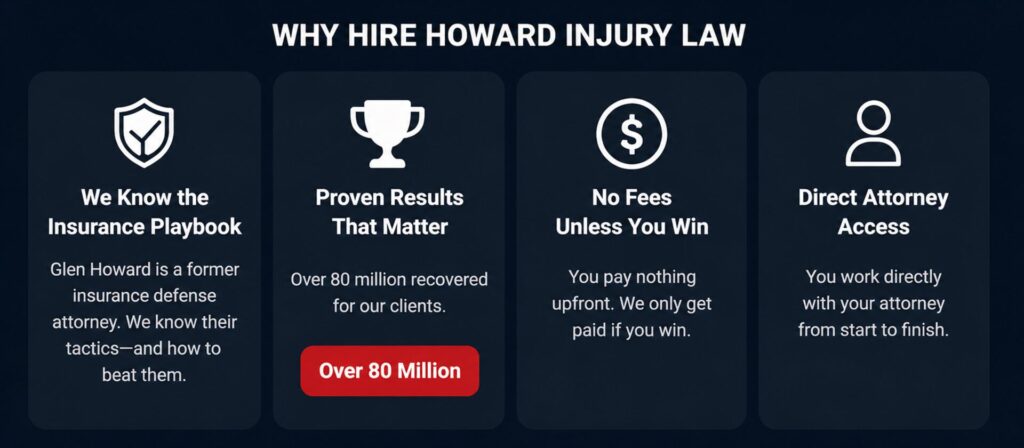
At Howard Injury Law, your attorney leads your case from first call to final settlement. Our case managers and support staff work alongside the attorney — coordinating records, managing timelines, keeping communication moving — but the legal strategy, negotiations, and decisions are attorney-driven. You have direct access to your attorney and you use it throughout the case.
Ask any firm you’re evaluating directly: who will I be communicating with day-to-day, and when will I speak to my attorney? For more on what attorney-led representation looks like versus the settlement mill model, read our guide on trial lawyers vs settlement mills — what’s the difference.
Response Time and Availability
Personal injury cases don’t operate on business hours. Accidents happen at night and on weekends. Evidence disappears within 72 hours. When something significant happens in your case, you need to be able to reach your attorney.
Howard Injury Law is available 24/7. When you compare law firms in Las Vegas, ask specifically about after-hours availability and response time expectations. A firm that only operates Monday through Friday during business hours creates real gaps in a case that requires timely action.
Compare the Actual Differentiators
Once you’ve evaluated the standard factors — specialization, track record, reputation, fees, communication — look for the differentiators that separate genuinely exceptional representation from competent representation.
Insurance Defense Experience
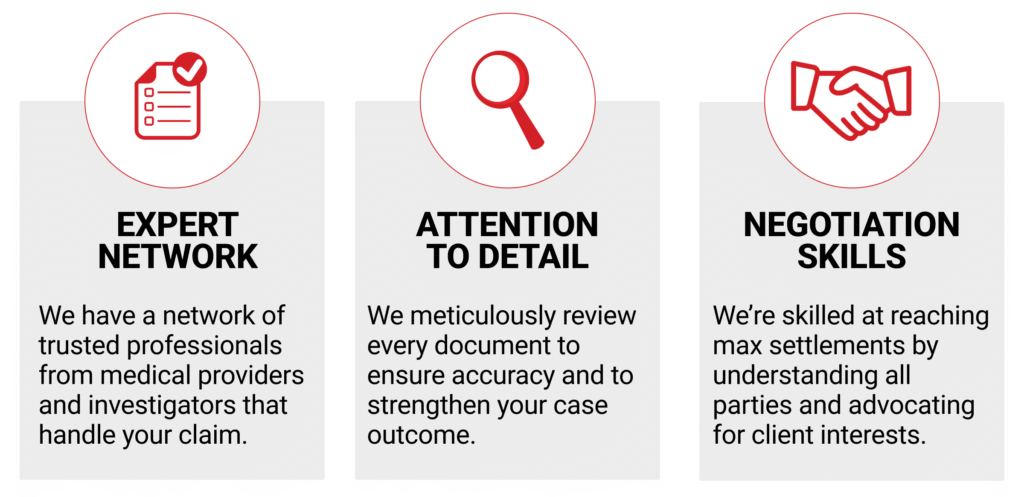
Most personal injury attorneys learned how insurance companies operate by fighting them. Howard Injury Law’s attorneys bring something different — direct insurance defense experience. We’ve worked on the defense side of personal injury claims. We know how insurers evaluate files, what arguments they favor, what evidence they prioritize, and where their positions are vulnerable.
That inside knowledge shapes how we build every case from the first appointment. We anticipate the defense before it’s raised. We document what insurers try to use against injured clients. When they make a lowball offer, we know whether it reflects genuine case value or a negotiating tactic — because we’ve made those same offers from the other side.
When you compare law firms in Las Vegas, ask specifically whether any attorney has worked on the insurance defense side. It’s a question most firms can’t answer yes to.
Trial Readiness
The question isn’t just whether a firm has gone to trial — it’s whether the attorney handling your file is genuinely prepared to go to trial on your case specifically. Ask what trial preparation looks like for a case like yours. Ask how many cases the attorney has tried in Nevada in the last three years. Ask what happens to your case if the insurer’s final offer is below fair value.
An attorney who answers those questions with specificity and confidence is building your case differently than one who deflects toward settlement language.
Local Knowledge
Las Vegas personal injury cases have specific local dimensions. NDOT camera systems at major intersections along Flamingo, Tropicana, and Charleston. High tourist accident volumes near the Strip and resort corridors. Clark County jury tendencies. Local insurer relationships and settlement patterns.
A firm that has practiced in Las Vegas for years understands these dimensions. A national or out-of-state firm handling Nevada cases remotely does not. Local experience is a genuine advantage in a market as specific as Las Vegas.
The Comparison Framework — Applied
When you sit down to compare law firms in Las Vegas, run each firm through these five questions:
Does this attorney personally specialize in my case type and have verifiable experience with it?
Does the firm have a demonstrated trial record — not just settlement totals?
Is the fee structure transparent, complete, and documented in writing?
Will I have direct access to the attorney throughout my case — not just at the consultation?
Does the firm bring any genuine differentiator — trial experience, insurance defense background, local knowledge — that affects case outcomes?
A firm that answers all five clearly and specifically is worth serious consideration. For a complete list of specific questions to ask any firm during an in-person evaluation, read our guide on questions to ask during a personal injury consultation.
Frequently Asked Questions
How many law firms should I consult before deciding?
There’s no rule — but consulting two or three gives you a useful comparison baseline. The first consultation calibrates your expectations. The second and third let you compare how different attorneys assess the same case. You may find significant differences in both the assessment and the communication quality.
Does it matter where a firm’s office is located in Las Vegas?
For most personal injury cases, not significantly. Court filings, evidence gathering, and negotiations can be managed from anywhere in Clark County. What matters more is the attorney’s familiarity with local courts, local insurers, and local case patterns — which comes from years of practice in the market, not physical proximity to your home.
Can I switch firms if I’m unhappy with my current representation?
Yes. In Nevada, a client can terminate a legal representation at any time. The prior attorney may assert a lien for work already performed — but that doesn’t prevent you from changing representation. If your current firm isn’t meeting your expectations, get a second opinion before deciding whether to stay or move.
How do I verify a Nevada attorney’s credentials?
Search nvbar.org for the attorney’s license status and disciplinary history. For peer credentials, Martindale-Hubbell, Best Lawyers, and Super Lawyers publish ratings based on peer and client reviews. These aren’t definitive — but they provide an additional data point beyond the firm’s own marketing.

The Right Comparison Leads to the Right Outcome
Knowing how to compare law firms in Las Vegas isn’t about being a difficult client. It’s about making a decision with accurate information — before you sign anything, before your case is shaped by choices you didn’t fully understand, and before you’ve committed to representation that may not serve your best interests.
The firms that welcome these questions are the firms worth hiring. The ones that deflect, overpromise, or rush past the hard parts of the evaluation are showing you something important before you’ve made any commitment.
Howard Injury Law welcomes every question on this list. Free consultations available 24/7. Call (702) 331-5722 or contact us here.