

Who pays after a crash in Nevada usually comes down to one question: which driver broke a rule? Motor vehicle traffic laws in Nevada set the standard every driver is measured against, and the driver who ignores that standard is the one who ends up responsible for the injuries and damage that follow.
This is a plain-English guide to the rules of the road across the Silver State — speed, phones, senior renewals, school zones, and more — plus what each one means if you were hurt by someone who didn’t follow them. If another driver’s violation left you injured, understanding these rules is the first step toward a motor vehicle accident claim in Las Vegas.
Nevada Is an At-Fault State — Why Traffic Laws Decide Who Pays
Nevada uses an at-fault system, which means the driver who causes a collision is legally responsible for the resulting injuries and property damage. There’s no minimum injury threshold to clear, so even a modest injury or a fender-bender can support a claim against the driver who caused it. If you’ve wondered whether the state works differently, the short answer is no — Nevada is not a no-fault state.
Traffic laws are the backbone of that system. When a driver breaks a clear safety rule — running a red light, speeding, texting behind the wheel — and that violation causes a crash, the broken rule becomes strong evidence that the driver was careless. Insurance companies know this, which is why so much of a claim turns on proving exactly what the other driver did wrong. That’s the heart of how fault is determined in a motor vehicle accident.
Every crash is different, and the specific rule that applies depends on the facts. But the pattern holds across nearly every case: the more clearly the other driver violated a traffic law, the stronger your position.
Nevada’s Core Rules of the Road
Nevada’s traffic code covers hundreds of situations. A handful of core rules come up again and again in real Las Vegas crashes, and these are the ones worth knowing.
Speed Limits — and Whether “5 Over” Is Really Legal
A common myth is that Nevada gives drivers a built-in cushion of a few miles per hour. It doesn’t. Any speed above the posted limit is technically a violation, so driving five over is still speeding under state law — even if officers often focus their attention on faster drivers.
Nevada also follows a “basic speed” rule: you have to drive at a speed that’s reasonable for the actual conditions. On a clear day that might be the posted limit, but during a sudden desert rainstorm on I-15 or a dust storm on the 215 Beltway, the safe and legal speed can be well below the sign. A driver can be cited for going too fast for conditions even when they’re under the limit.
Speed limits climb in school zones — typically 15 mph when the beacons are flashing or children are present — and fines double in both school zones and work zones. For an injured person, this matters: if the driver who hit you was speeding, even a little, that violation is powerful evidence they were at fault.
The “No-Touch” Cell Phone Law
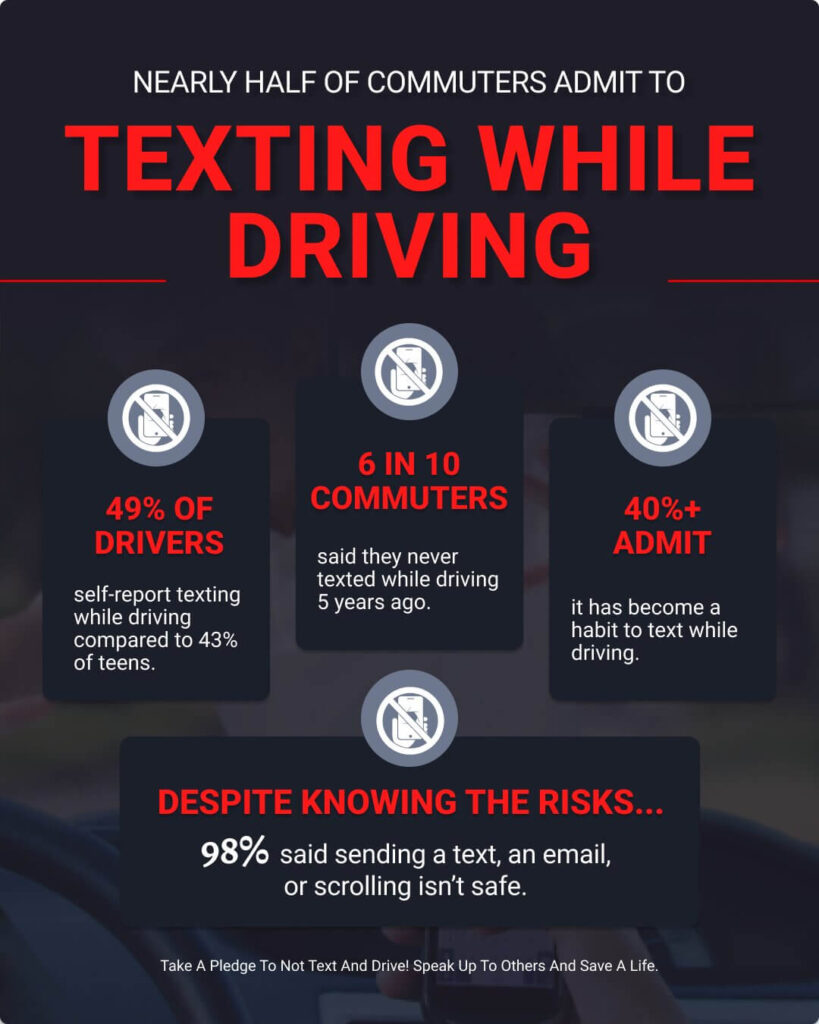
Nevada’s handheld law is often called a “no-touch” law, and the nickname is accurate. Drivers can’t hold a phone to text, read, dial, or scroll behind the wheel. Voice commands and true hands-free setups — a mounted phone, Bluetooth, a dashboard system — are allowed, and there are narrow exceptions for genuine emergencies.
Holding the phone at a red light still counts, and so does glancing at a map app in your hand. Because distracted driving is one of the most common causes of Las Vegas crashes, a driver caught using a phone at the time of a wreck often faces an uphill battle proving they were paying attention. For the full breakdown of fines and how repeat offenses stack up, see our guide to texting and driving laws in Nevada.
Reckless and Aggressive Driving
Reckless driving is more than a bad habit — it’s a willful or wanton disregard for the safety of people or property. Street racing, weaving at extreme speed, and aggressive road-rage maneuvers all fall into this category, and they can carry criminal charges on top of civil liability. When aggressive behavior causes a crash, it tends to point squarely at the aggressive driver.
Right-of-Way, Unsafe Backing, and the Move-Over Law
Everyday rules cause a large share of collisions. Drivers must yield the right-of-way at intersections and crosswalks, and they can’t back up unless it’s safe to do so without cutting off other traffic or pedestrians. Nevada’s move-over law requires drivers to slow down or change lanes for emergency, tow, and maintenance vehicles stopped on the shoulder. Motorists also have to give bicyclists at least three feet of space when passing. Break one of these rules and cause a crash, and fault usually follows the violation.
The New Senior Driver Rules in Nevada (65+)
A lot of families search for a “new rule” targeting older drivers, worried a parent is about to lose their license. Here’s the reassuring truth: Nevada has no age cap and no law that automatically restricts seniors. What it has is a stricter renewal process designed to check in more often.
Drivers 65 and older renew their license every four years instead of the standard eight, and they take a vision test at renewal. Once a driver turns 71, online renewal is no longer an option — they renew in person or by mail with an eye-exam certificate, and the vision test is required every time. Failing a vision screening usually doesn’t mean losing driving privileges; more often it means a corrective-lens restriction. These rules exist to keep experienced drivers safely on the road, not to push them off it.
Age alone doesn’t decide fault after a crash, either. A senior driver hit by a careless motorist has the same rights as anyone else, and being an older driver doesn’t make you responsible for someone else’s mistake. If a crash has raised questions about an older loved one’s rights, our team that works with senior accident victims in Las Vegas can help sort it out.
Rules That Protect Kids and Passengers
Nevada puts extra protections around children on the road. Young kids must ride in an approved child-restraint system sized to their age and weight, and older children and adults are expected to buckle up. School zones and school crossings carry reduced speed limits and crossing-guard signals that drivers must obey, with enhanced penalties for violations.
These rules come up constantly in crashes involving families, school areas, and neighborhood streets across Spring Valley, Summerlin, and Henderson. Our community resource on keeping kids safe in cars walks through the practical side of getting restraints right.
Insurance Is Part of Nevada’s Traffic Laws Too
Carrying insurance isn’t optional in Nevada — it’s a legal requirement, and driving without the minimum coverage brings its own penalties. In an at-fault state, that coverage is what actually pays your claim: you file against the responsible driver’s liability policy for medical bills, lost wages, and pain and suffering.
The wrinkle comes when the at-fault driver has no insurance, or not enough to cover serious injuries. That’s when your own uninsured/underinsured motorist coverage steps in, and it’s worth understanding your options before you need them. We cover this in detail in what to do if the other driver doesn’t have insurance.
What Breaking Nevada’s Motor Vehicle Traffic Laws Means for Your Case
Here’s why all of this is worth knowing when you’re hurt. A traffic-law violation by the other driver is often the single strongest piece of evidence that they — not you — are responsible for the crash. Whether it’s a rear-end wreck at Sahara and Decatur, a red-light T-bone off Tropicana, or a distracted-driving pileup on US-95, the violation is where a claim starts. And the same principle applies whether you were in a car, on a motorcycle, in a rideshare, or hit as a pedestrian — who is liable in a Nevada motor vehicle accident usually traces back to a broken rule.
Las Vegas has its own crash pressure points — heavy tourist traffic, a transient population, and a 24-hour road culture that keeps the corridors busy at every hour. We track where these wrecks concentrate; you can see the patterns in our data on crash hotspots in Las Vegas.
This is also where experience changes the outcome. Attorney Glen Howard spent years on the insurance-defense side before founding the firm, so he knows exactly how insurers downplay a violation, shift blame onto the injured person, or argue a rule “didn’t really apply.” A Las Vegas motor vehicle accident lawyer who has sat in the other chair can spot those tactics early and build the claim to withstand them — across all of the crash types Howard Injury Law handles.

Frequently Asked Questions
Can You Go 5 Miles Over the Speed Limit in Nevada?
No — Nevada doesn’t have a legal buffer above the posted limit. Driving five miles per hour over is still speeding under state law, even though officers often concentrate on faster drivers. Nevada also enforces a “basic speed” rule, meaning you can be cited for driving too fast for conditions even when you’re under the limit — think heavy rain on I-15 or a dust storm on the 215. Fines rise with the amount over the limit, and speeding in a school or work zone doubles them. If the driver who hit you was speeding at all, that violation can be strong evidence of fault in your injury claim.
What Is the Nevada “No-Touch” Law?
Nevada’s “no-touch” law is the state’s handheld cell phone ban. Drivers can’t hold a phone to text, read, dial, browse, or scroll while operating a vehicle — including while stopped at a red light. Hands-free use is legal: a mounted phone, Bluetooth, voice commands, or a built-in dashboard system. Narrow exceptions exist for true emergencies and certain on-duty responders. Because distracted driving causes so many Las Vegas crashes, a driver who was using a phone at the moment of a collision often has a hard time arguing they were attentive — which can strengthen an injured person’s case against them.
What Is the New Rule for Senior Drivers in Nevada?
There’s no new law that bans or automatically restricts senior drivers in Nevada, and there’s no maximum driving age. What people are usually referring to is the state’s stricter renewal process for older drivers. Drivers 65 and older renew every four years — rather than the standard eight — and take a vision test at renewal. At 71 and older, online renewal is no longer available, and the vision test is required at every renewal. Failing a vision screening typically leads to a corrective-lens restriction, not an automatic loss of license. The goal is regular check-ins, not pushing experienced drivers off the road.
Does a Traffic Ticket Prove the Other Driver Was at Fault?
Not automatically, but it helps a lot. A citation is strong evidence that the other driver broke a traffic law, and in Nevada an at-fault system ties responsibility to exactly that kind of carelessness. A ticket isn’t the final word — insurers still dispute fault, and every case turns on its own facts — but it’s often a powerful starting point. Photos, witness statements, and the police report all build on it. If the driver who hurt you was ticketed, an attorney can use that violation as the foundation of your claim while gathering the rest of the evidence.

Hurt by a Driver Who Broke the Rules? Talk to Howard Injury Law
If another driver ignored one of these rules and left you injured, you probably want a straight answer to one question: do you have a case? That’s exactly what a free consultation is for. We’ll look at the violation, the crash, and your injuries, and tell you honestly where you stand — with no fee unless we win your case.
You don’t need to memorize Nevada’s traffic code to protect your rights. You need someone who already knows it cold, understands how insurers think, and handles every type of Las Vegas motor vehicle crash. Request your free case review and let a Nevada attorney tell you whether the rule broken in your crash means you have a claim worth pursuing.