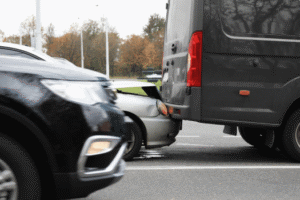


You were barely moving — creeping past the Spaghetti Bowl on I-15, or sitting in the usual afternoon backup on US-95 — when the driver behind you didn’t stop in time. Getting rear-ended in stop-and-go traffic is one of the most common crashes in Las Vegas, and one of the most underestimated by the insurance adjuster who calls a few days later.
Here’s what that adjuster won’t tell you: a “slow-traffic” crash can still hit hard enough to injure your neck and spine, and under Nevada law the driver who ran into you is usually the one presumed at fault. This guide walks through why these crashes happen on our freeways, what a moderate-speed impact does to your body, and how fault actually works — so you can decide your next move from a position of knowledge instead of pressure.
Why stop-and-go traffic on I-15 and US-95 causes so many rear-end crashes
Freeway congestion in the Las Vegas Valley doesn’t flow evenly. It pulses. Traffic bunches up, stops, then lurches forward — the “accordion effect” that ripples backward through miles of vehicles. Every time that wave reaches a driver who’s following too closely or glancing at a phone, someone gets rear-ended.
A few stretches see this constantly. The I-15 resort corridor loads up with visitors and commuters at all hours. The Spaghetti Bowl, where I-15 meets US-95 and I-515, forces heavy merging into slowing lanes. US-95 through downtown and out toward the northwest backs up during rush hour like clockwork. Add construction zones and lane shifts, and you get exactly the conditions rear-end crashes need: high closing speeds meeting sudden stops.
The dangerous part isn’t the traffic jam itself — it’s the gap between how fast the rear driver is going and how suddenly the traffic ahead stops. A driver doing 40 mph who looks up to a wall of brake lights simply runs out of room.
The usual causes behind these crashes
Most stop-and-go rear-end wrecks trace back to a short list of driver choices:
- Chupar rueda Following too closely leaves no room to stop when traffic bunches. It’s the classic cause, and Nevada treats it as a violation. We break down how it plays out in a Las Vegas tailgating accident.
- La distracción. A two-second glance at a phone at 40 mph covers more than 100 feet — often the exact distance that would have let the driver stop.
- Speeding into slowing traffic. Drivers treat wide valley freeways like open road, then can’t scrub off speed when the flow breaks.
- Following the car ahead too fast off a stop, then getting caught when it brakes again.
What happens to your body when you’re hit at 30–40 mph while stopped
A lot of people search some version of “what happens if you get hit by a car going 40 mph?” — usually because their car looks fine and they’re trying to figure out if their aching neck is a real problem. It is.
When you’re stopped or barely rolling and a vehicle strikes you at freeway speed, almost all of that energy transfers into your car and your body at once. Your seat pushes your torso forward while your head lags behind for a split second, then snaps forward — the rapid back-and-forth motion that causes whiplash. Because the hit is unexpected, you never brace for it, and unbraced bodies absorb force worse than braced ones.
A 40 mph impact is often called “moderate,” but that label is misleading. The forces involved are enough to strain ligaments, bulge or tear spinal discs, and rattle the brain inside the skull. Crumple zones and airbags absorb some of it, which is exactly why the bumper can look survivable while the person inside is hurt.
Why neck and back injuries are so common in these wrecks
The rear-impact motion targets the neck and spine more than almost any other crash type. That’s why rear-end victims so often deal with:
- Whiplash and soft-tissue neck strain
- Bulging or herniated discs — see our page on reclamaciones por hernia discal en colisiones por alcance
- Concussions, even without hitting your head — more on whether you can get a concussion from a rear-end collision
- Lower-back and lumbar injuries
Symptoms often show up hours or days later, once the adrenaline fades. Feeling “okay” at the scene doesn’t mean you weren’t hurt.
Who’s at fault when you’re rear-ended in Las Vegas traffic
Being stopped in traffic is not negligence. You did what the road required. The driver behind you had a legal duty to leave enough space to stop — Nevada’s following-too-closely law (NRS 484B.127) requires every driver to keep a distance that’s “reasonable and prudent” for the speed and conditions. In stop-and-go traffic, that duty is at its highest, because everyone knows the flow can halt at any second.
For that reason, the rear driver is usually presumed at fault in these crashes. That presumption is a strong starting point, but it isn’t automatic — the front driver can share blame in specific situations, such as broken brake lights or a sudden, unexplained lane change. Nevada also follows a modified comparative negligence rule, so an insurer may try to pin a percentage of fault on you to shrink what they pay. You can see how these disputes get handled across our rear-end accident practice y el más amplio Accidente automovilístico en Las Vegas recursos.
Every crash turns on its own facts, so treat this as general information rather than advice about your specific case — a quick conversation with an attorney will tell you where you actually stand.
What if you were pushed into the car ahead?
Stop-and-go crashes often become chain reactions. If you were struck from behind and shoved into the vehicle in front of you, the force came from behind — not from anything you did. That usually means you’re not to blame for the second impact, though the rear driver’s insurer may try to argue otherwise. We cover this exact scenario in rear-ended and pushed into the car ahead.
What to do after a freeway rear-end
The freeway adds a layer of danger to the usual aftermath, because you’re stopped in live lanes. Once you’re hit:
- Move to the right shoulder or nearest exit if the cars are drivable and it’s safe. Turn on your hazards.
- Call 911 if anyone is hurt or vehicles are blocking traffic.
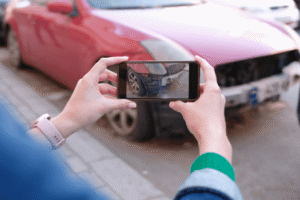
- Exchange insurance and contact information, and photograph the scene, vehicle positions, and damage before anything moves.
- See a doctor promptly, even if you feel fine — delayed symptoms are the norm with rear-impact injuries.
For the complete step-by-step, read Qué hacer inmediatamente después de sufrir un choque por alcance en Las Vegas.. And because these crashes cluster on our freeways, our highway accident guidance for I-15, US-95, and I-215 covers the wider picture of freeway wrecks in the valley.

Preguntas frecuentes
What happens if you get hit by a car going 40 mph?
A 40 mph rear-end impact is far from harmless, even when your car looks intact. At that speed, your vehicle can stop almost instantly while your body keeps moving until the seat belt, airbag, or seat catches it. That sudden deceleration commonly causes whiplash, bulging or herniated discs, concussions, and lower-back injuries. Crumple zones and airbags absorb some energy, which is why bumper damage often looks minor next to the injuries inside. The takeaway: don’t let light visible damage convince you — or an adjuster — that you weren’t really hurt. Get checked by a doctor and document everything.
Who is at fault if I was rear-ended in stop-and-go traffic?
In most stop-and-go rear-end crashes, the driver who hit you is presumed at fault, because Nevada law requires every driver to keep a safe following distance for the conditions. Sitting in stopped traffic is not negligence on your part. That presumption is strong but not absolute — the front driver can share fault in limited situations, like non-working brake lights or an abrupt, unjustified lane change. Insurers know the presumption favors you, so they often look for a way to assign you partial blame and reduce the payout. Solid evidence from the scene is what protects you against that.
My car barely has damage — do I still have a claim?
Yes, potentially. Vehicle damage and bodily injury don’t track together, especially in rear-end crashes. Modern bumpers are built to absorb low-to-moderate impacts and spring back, so the outside can look fine while your neck, back, or brain took real force. Insurance companies lean on the “minor damage, minor injury” argument constantly, but it isn’t a rule of physics or of Nevada law. What matters is your medical documentation. If a doctor connects your injuries to the crash, the appearance of your bumper doesn’t get to decide the value of your claim.
I felt fine at the scene but hurt the next day — is that normal?
Very. Adrenaline masks pain in the minutes and hours after a crash, and injuries like whiplash, disc problems, and concussions frequently take a day or two to announce themselves. That’s one reason getting evaluated quickly matters — it protects your health and creates a medical record tying the injury to the crash. Waiting too long gives an insurer room to argue your pain came from something else. If new symptoms appear after a stop-and-go rear-end, see a doctor and keep the paperwork.

Talk to a Las Vegas car accident lawyer who knows the insurer’s playbook
If you were rear-ended in stop-and-go traffic on I-15, US-95, or anywhere in the valley and you’re now hurting or getting pressure from an adjuster, the smartest first step is understanding what your claim is actually worth before you agree to anything.
Howard Injury Law was founded by attorney Glen Howard, who spent years defending insurance companies before he switched sides. He knows how carriers turn a “minor” freeway fender-bender into a lowball offer — because he used to build those arguments. Now that experience works for you. We take rear-end cases on contingency, so there’s no fee unless we win, and the consultation is free.
Not sure you even have a case? That’s exactly what a free consultation answers. Nevada generally gives you two years from the date of the crash to file, but evidence fades and memories blur long before then — the sooner you get answers, the stronger your position. Call (702) 331-5722 or Contáctenos a través de nuestra página de contacto to find out where you stand, with no obligation.