


Short answer: in Nevada, the rear driver is usually presumed at fault in a rear-end collision — but not always. Fault turns on what actually happened, and the driver in back can absolutely have a valid claim of their own.
If you’re reading this with a stiff neck and an adjuster already hinting the crash was “on you,” take a breath. A presumption is a starting point, not a verdict. Nevada law leaves real room to prove the front driver caused or contributed to the wreck — and that difference can decide whether you walk away with nothing or with a settlement that covers your injuries.
Who Is Usually at Fault in a Rear-End Collision?
Most of the time, the driver who hits the car in front is found at fault. That’s not because of a special “rear driver rule” — it’s because of a basic duty every Nevada driver has to keep a safe distance and stay ready to stop.
Nevada’s “following too closely” rule
Under Nevada law (NRS 484B.127), a driver can’t follow another vehicle more closely than is reasonable and prudent, given the speed, the traffic, and the road conditions. In plain terms: you have to leave enough space to stop safely if the car ahead brakes.
When a rear-end crash happens, insurers assume the driver in back either followed too closely or wasn’t paying attention — classic tailgating. That assumption is why the rear driver starts out on the defensive. But “reasonable and prudent” is a judgment call, not a switch. If something outside the rear driver’s control triggered the collision, that presumption can be challenged and, often, overcome. If you want the deeper breakdown of that specific violation, our overview of a tailgating accident in Las Vegas walks through how it plays out.
Is the Rear Driver Always at Fault? (No — Here’s Why)
No. Nevada does not automatically assign 100% of the blame to whoever rear-ended someone. Fault is based on evidence — the driving, the road, the vehicles, witness accounts, camera footage — not on car positions alone.
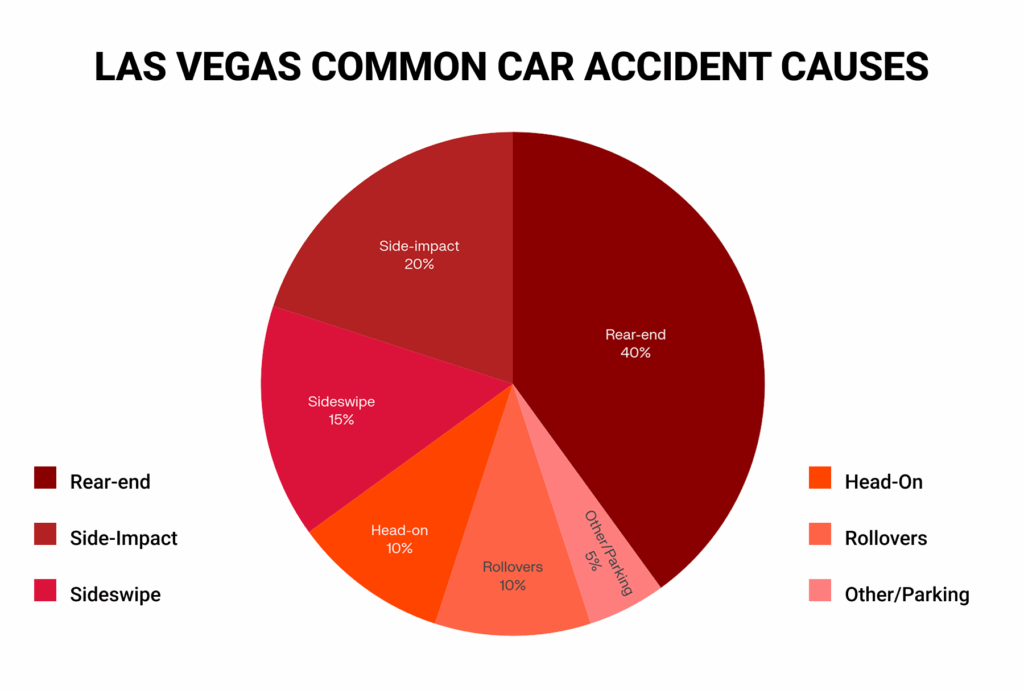
Insurance companies love the shortcut of “rear driver = at fault” because it’s fast and it saves them money. It isn’t the law. A rear-end crash on I-15 in stop-and-go traffic, at a red light near Sahara & Decatur, or on a busy stretch of the Strip can unfold in ways that put real fault on the driver in front. The job is to show what actually caused the impact.
When the Front Driver Shares the Blame
These are the scenarios where the driver who got hit may be partly — or even mostly — responsible. Each one deserves its own close look, but here’s the overview.
Brake-checking or a sudden, unnecessary stop
If the lead driver slams on the brakes out of road rage or to “teach a lesson,” and there was no reason to stop, they can share fault for the crash. Nevada expects drivers not to create sudden hazards for the traffic behind them.
Broken or non-working brake lights
You can only react to a stop you can see coming. If the front car’s brake lights were burned out or malfunctioning, the rear driver lost the warning they were entitled to — and fault can shift accordingly.
Rear-ended and pushed into the car ahead
In a chain reaction, the middle car often gets blamed for hitting the vehicle in front when it was shoved there by the car behind. That driver is frequently a victim, not the cause. We cover this exact situation in rear-ended and pushed into the car ahead — who’s liable?.
A reckless lane-cut, reverse, or unsafe merge
When a driver darts in and brakes hard, backs up unexpectedly, or merges without leaving room, the rear driver may have had no realistic chance to avoid contact. Those facts matter, and they can move fault to the other vehicle.
How Nevada Handles Shared Fault (the 51% Rule)
Here’s the part most people don’t know: even if you’re found partly at fault, you can still recover in Nevada.
Nevada uses modified comparative negligence (NRS 41.141). As long as you’re not more at fault than the other driver — generally 50% or less — you can still collect, with your award reduced by your share of the blame. If a claim is worth $100,000 and you’re assigned 20% of the fault, you recover $80,000. Cross past the halfway line, though, and recovery is barred — which is exactly why insurers fight to pin extra blame on you. For a fuller walkthrough of how those percentages get assigned, see our guide to comparative negligence in Nevada.
The takeaway: being told you “share fault” is not the end of your case. It’s often the opening move in a negotiation.
Is Nevada a No-Fault State?
No. Nevada is an at-fault (tort) state, not a no-fault state. That means the driver who caused the traffic accident — and their insurance company — is responsible for the resulting injuries and damages. You’re not locked into only using your own coverage. We break the whole concept down in is Nevada a no-fault state?
Why Insurance Adjusters Push the “You’re at Fault” Story
Attorney Glen Howard spent years on the other side of these claims, defending insurance companies before he started fighting for injured people. That background is the reason HIL sees the adjuster’s playbook coming.
The strategy is predictable. Assign fault fast, before you’ve talked to anyone. Anchor you to a lowball number. Treat the rear-end presumption as if it settles everything. A recorded statement where you say “I didn’t see them stop” becomes their evidence. Knowing how the other side builds that blame narrative — and where it falls apart — is how you keep a manufactured “you’re at fault” label from quietly cutting your claim in half.
What to Do If You’re Being Blamed for a Rear-End Crash
If fault is landing on you and you don’t think it’s fair, a few things protect your position:
- Get checked out. Neck and back injuries from rear-impact crashes often surface a day or two later. A medical record ties the injury to the wreck.
- Preserve evidence. Photos, dashcam or nearby business footage, the other driver’s brake-light condition, and witness contacts all matter.
- Be careful with recorded statements. You’re not required to give the other driver’s insurer one on the spot.
- Know that a disputed rear-end claim is still a claim. When liability is contested, that’s a reason to get counsel involved, not to walk away.
Our step-by-step guide on what to do immediately after being rear-ended in Las Vegas covers the first 48 hours, and if the other side is actively blaming you, disputed liability car accident claims in Las Vegas explains how those fights get resolved.

Frequently Asked Questions
Are you ever not at fault if you rear-end someone?
Yes. While the rear driver is usually presumed responsible, that presumption can be overcome with the right facts. If the driver in front brake-checked you, had non-working brake lights, cut in and stopped short, or reversed into you, fault can shift partly or fully to them. Nevada decides fault on the evidence — driving behavior, vehicle condition, footage, and witnesses — not on car position alone. Even in a chain reaction where you were pushed into the car ahead, you may be a victim rather than the cause. Being the rear driver puts you on the defensive, but it does not automatically make you liable.
Can the front driver be at fault in a rear-end collision?
Absolutely. The front driver can share or carry the blame in several situations common on Las Vegas roads: slamming the brakes for no reason, driving with burned-out brake lights, making an unsafe lane change or merge, or reversing unexpectedly. Under Nevada’s comparative negligence rule, fault is divided by percentage among everyone who contributed to the crash. So a rear-end wreck isn’t always 100% on the driver in back — it can be split, or even land mostly on the driver in front, depending on what the evidence shows about how the collision actually happened.
How long does a rear-end collision settlement take?
It depends on the injuries and whether fault is disputed. A straightforward claim with clear liability and a full recovery can settle in a few months. When the insurer is contesting fault, or you’re still treating for neck, back, or other injuries, it often runs longer — sometimes a year or more — because rushing to settle before you know the full extent of your injuries usually costs you money. Keep in mind Nevada generally gives you two years from the crash to file a lawsuit, so a slow negotiation shouldn’t mean missing that deadline. Our rear-end accident team can give you a realistic timeline for your situation.
Does being partly at fault mean I get nothing in Nevada?
No. Nevada follows modified comparative negligence, so partial fault does not erase your claim. As long as your share of the blame isn’t greater than the other driver’s — generally 50% or less — you can still recover, with your compensation reduced by your percentage. The one hard line is 51%: if you’re found more than half at fault, recovery is barred. That’s precisely why insurers push to inflate your share of the blame, and why pushing back on an unfair fault percentage can be worth real money. Every crash is different, so it’s worth having an attorney review how fault is being assigned in your case.

Talk to a Las Vegas Rear-End Accident Attorney
If an adjuster has already decided you’re at fault, you don’t have to accept it — and you shouldn’t guess about it either. The question worth answering is simple: does the evidence actually support the blame being put on you? That’s what a free case review answers.
Howard Injury Law handles rear-end collision cases across Las Vegas, Henderson, Summerlin, and Spring Valley, and Glen Howard’s insurance-defense background means we know exactly how the other side builds — and inflates — a fault argument. There’s no fee unless we win, so finding out where you stand costs you nothing.
Request your free consultation and tell us what happened. We’ll give you a straight answer on whether the fault being assigned to you holds up — and what your claim may really be worth.